



Replacing worn casement fittings in an occupied building is not a simple parts swap. A hinge can sag, a drive can lose travel, or a seal can add resistance while the facade still looks acceptable. Retrofit success depends on matching each replacement to the existing profile, load path, spindle, locking points, drainage details, service conditions, and maintenance history.
A retrofit package must be matched to evidence from the installed window, including parts that remain in the frame. CMECH coordinates handles, drives, locks, hinges, and support components for buyers who need a documented replacement path across occupied buildings and different construction phases.
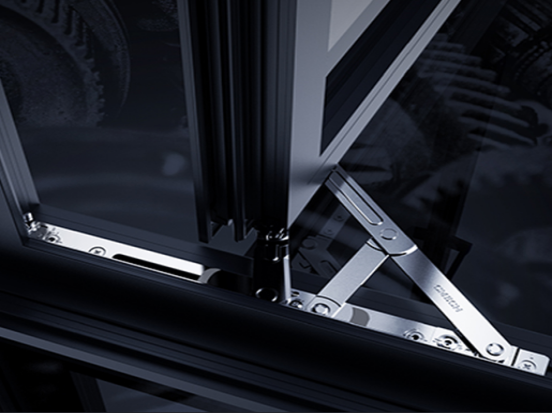
Retrofit Load Paths Reveal Why Parts Fail
An outward-opening sash transfers gravity through its hinge into the profile while the handle and drive pull the locking edge against seals. If one part wears, neighboring components absorb the missing control. A loose hinge changes the sash plane; a tired drive increases handle effort; a compressed gasket adds resistance. The failure appears local, but the load path is shared across the assembly.
This matters because replacement parts can recreate the original weakness if selected independently. A stronger handle cannot correct a distorted hinge side, and a new lock cannot compensate for a sagging sash. We inspect how profile, reinforcement, hinge, spindle, and sealing line interact before deciding which casement hardware should be replaced and which parts can remain in service.
The engineering consequence is practical: retrofit decisions should preserve the intended force route. When load enters the hinge and closes through the drive as designed, the window can regain smooth operation and weather contact. When parts are mixed without dimensional checks, the operator may feel temporary improvement while underlying misalignment enlarges gaps and accelerates wear.
Which Records Should Guide Global Replacement Sourcing?
We begin with field records: sash width, height, estimated mass, frame depth, hinge position, spindle size, lock-body centerline, and visible drainage paths. Photographs help identify geometry, but measurements confirm compatibility. We also record opening effort and gasket condition because resistance may come from seal compression rather than a defective handle or drive assembly during service.
For casement window hardware kit, the published outswing solution covers sash widths of 400–750 mm, heights of 450–1,800 mm, and loads up to 50 kg. Its 10 mm spindle is designed to provide greater torsional rigidity than a conventional 7 mm spindle. These figures give procurement teams a defined boundary when replacing parts across buildings and elevations.
Consider a property group refurbishing 180 hotel rooms with outward-opening windows from several construction phases. If one replacement is ordered by appearance alone, spindle length or hinge capacity may differ between elevations. Our selection rule is clear: use a casement window hardware kit when profile, load, and locking geometry are verified; use isolated replacements only where those interfaces are documented and repeatable.
Testing Separates Wear From Profile Distortion
Before removing parts, retrofit technicians can cycle a representative sash and record where operating resistance increases. A stiff beginning suggests gasket drag or hinge friction; resistance near the closed position may indicate lock alignment. If the handle rotates freely but the sash remains loose, the drive may have lost engagement. This sequence prevents a new component from masking a structural issue.
We then compare unloaded and supported measurements. A change in reveal after the sash is lifted points toward hinge sag or profile movement, while unchanged gaps with rising torque suggest the drive or seal line. Retrofit technicians should preserve these observations with the purchase record so a replacement decision remains traceable when the project spans countries, elevations, or subcontractors.
After installation, the retrofit team should test opening, partial closing, and locking to check the operation of the replaced hardware. We check spindle engagement, handle return, gasket compression, hinge stability, and drainage clearance. A hardware replacement should be assessed through operating cycles, component alignment, locking engagement, and sealing checks rather than screw-hole compatibility alone.
CMECH Components Support Coordinated Retrofit Packages
For a hotel portfolio renewal, CMECH supplies an outswing casement built-in solution with handles, drive parts, lock parts, load-bearing parts, and accessories. The casement window hardware replacement parts package uses a 10 mm spindle, carbon-steel drive gear with nano-blue treatment, a milling-free built-in hinge, and a slim 70 mm frame application. The hinge incorporates an anti-sag structure, a U-shaped reinforcement plate, and six solid rivets. The system has a specified maximum load of 50 kg.
The system also addresses conditions that commonly complicate retrofits. Triple sealing maintains a defined gasket path, fast exterior drainage protects the drive and hinge from moisture, and the real-fit profile ties replacement dimensions to the existing assembly. Before ordering parts for each elevation and project phase, buyers should verify spindle length, lock engagement, hinge settings, and profile reinforcement.
For this B2B program, our engineering verdict favors coordinated casement window hardware replacement parts when several building phases must be standardized without losing local compatibility. A generic replacement may suit one lightly used opening, but it is a weaker choice when load, weather exposure, and service accountability vary across a large property portfolio and maintenance schedule.
Retrofit Discipline Limits Future Service Risk
Group the hotel openings by verified profile, sash mass, spindle, and locking geometry before standardizing the order. Where those interfaces differ, retain separate configurations rather than forcing a common replacement into a window it was not selected to operate.
Keep survey measurements, photographs of removed components, torque readings, and final adjustments with each window record. That history supports subsequent maintenance while preserving the profile, drainage, and fastening checks needed before every retrofit is approved.


 English
 Arabic
 Chinese
 French
 Thai
 Vietnamese