



The most relevant window and door handle designs for 2026 combine clean profiles, matte or understated finishes, low-profile bases, ergonomic forms and coordination across related openings. CMECH offers several award-winning handle series aligned with these directions, but buyers should verify every model, finish and application before specifying or stocking it.
For importers, distributors and specifiers, modern window handle designs 2026 should not be judged by appearance alone. Profile compatibility, operating method and verified performance remain essential.
Quick selection guide
- Choose matte finishes for restrained contrast
- Choose slim profiles for narrow frames
- Choose low-profile bases to reduce bulk
- Choose ergonomic curves for repeated use
- Coordinate handles across related openings
Five handle design directions relevant to 2026 projects
1. Choose matte finishes for restrained contrast
Matte or low-reflective finishes reduce glare and help blend with dark aluminium frames, monochrome interiors and contemporary façades. Matte black window and door handles remain particularly relevant because they can coordinate with black profiles, seals and other visible hardware.
Colour is not proof of durability. A black finish may be painted, anodised or plated, and each process can perform differently. Confirm the exact treatment, corrosion evidence and intended environment.
All CMECH handles are available in black or matte-black finishes, including the Venice, Milan and Berlin collections.
For coastal or humid projects, matte black window and door handles should be assessed through product-specific material and corrosion information—not colour preference alone.
2. Slim and minimalist profiles
Minimalism controls outline, proportion and visual weight so the handle works with narrow frames and large glazed areas.
Slim door handle finishes should reduce visual heaviness without making the product uncomfortable. The handle still needs adequate grip clearance, installation space and leverage.
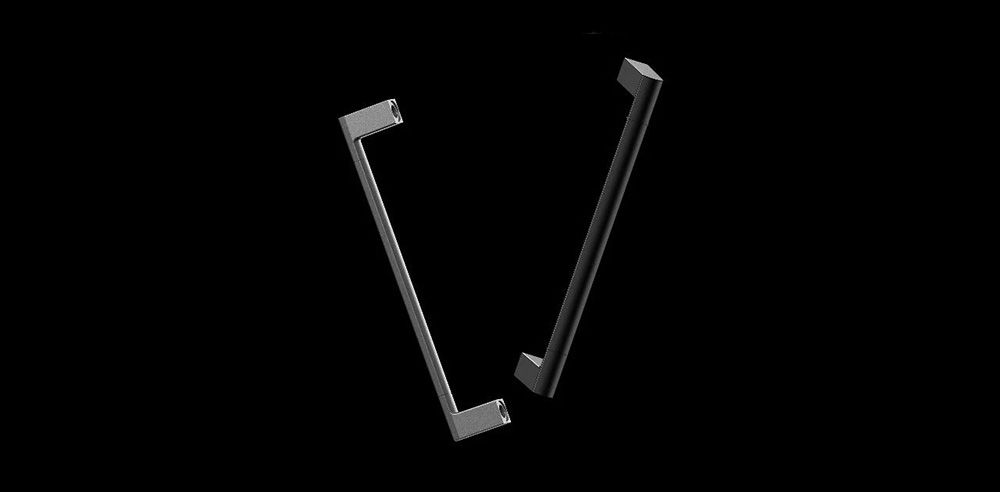
CMECH’s Milan Series uses a baseless form and restrained lines. Venice combines flowing curves with a lightweight-looking base, while Metro integrates the handle and lock into a distinctive operating structure. Each offers a different response to slim-frame coordination.
These modern window handle designs 2026 demonstrate that visual slimness can come from proportions, base reduction or structural integration—not only from reducing overall dimensions.
3. Choose low-profile bases to reduce bulk
Baseless and low-profile handles create a cleaner connection with the profile. Screw-free faces or concealed fixings can reduce visual clutter where the exact model supports them; these features should never be assumed across an entire series.
This direction is related to minimalist door handle finishes, but it focuses on construction as well as appearance. Fixing method, internal clearance and maintenance access still need to be resolved.
The CMECH Milan Series uses a baseless design. Venice uses a light, flowing base, while Metro integrates the unlocking cylinder with the handle and uses an up-and-down operating action.
Because installation methods differ, fabricators should check model-specific drawings and samples.
4. Ergonomic curves and comfortable operation
Ergonomic handle design considers more than rounded edges. Dimensions, balance, grip clearance and operating force all affect comfort.
Venice uses rounded forms and balanced proportions.Milan has a streamlined, baseless form that creates a clean, minimalist appearance. Berlin combines an upright body with curved sides and a fuller tail, while London uses subtle curves and a taut back profile.
For high-use projects, samples should be tested on a representative profile. A handle that looks refined alone may feel cramped once installed.
Ergonomics should therefore remain part of the evaluation of modern window handle designs 2026, alongside aesthetics and compatibility.
5. Coordinated design across windows and doors
A project may include casement windows, tilt-and-turn windows, sliding doors and hinged doors. Choosing unrelated handle shapes and colours can make the finished space feel fragmented.
Coordination does not require one identical handle everywhere. It requires related lines, proportions and confirmed finishes. Minimalist door handle finishes work best when they connect different openings rather than appearing as isolated choices.
CMECH’s Koln Series covers applications including tilt-and-turn windows, casement windows and lift-and-slide doors. Berlin also includes window and door applications. Project teams should map every opening type before selecting a series.
If one series cannot cover every opening, combine related series after checking form, finish and compatibility.
CMECH window and door handle designs series at a glance
| Window and door handle designs series | Design character | Relevant trend |
| Venice | Water-inspired curves and a lightweight rounded base | Ergonomic minimalism |
| Milan | Baseless, streamlined form | Baseless minimalism |
| Metro | Industry-first sliding handle design with an integrated lock | Functional integration |
| Berlin | Upright form with side curves and a fuller tail | Sculptural ergonomics |
| Koln | Restrained German-style lines | Cross-system coordination |
| London | Subtle curves, upright posture and a taut back | Balanced minimalism |
How should distributors and specifiers select a handle series?
Distributors should identify the opening types most relevant to their market. A distinctive series has limited value if it does not cover the required applications or finishes.
Specifiers should use a similar order of decisions:
- Confirm the window or door opening type.
- Check profile dimensions, installation space and hardware compatibility.
- Compare operating comfort and sample appearance.
- Confirm material and finish availability for the exact model.
- Review corrosion, cycle and warranty information relevant to the project.
- Confirm samples, minimum order quantity, lead time and technical support.
This process helps buyers distinguish practical slim door handle finishes from products that only appear slim in images.
Award-winning design backed by performance testing
A handle should look good and stand up to everyday use. CMECH’s Venice Series received the 2024 iF and 2025 Red Dot Design Awards, while Milan and Metro received Red Dot Design Awards in 2022, bringing international recognition to their design.
Alongside these awards, product testing provides evidence of durability. CMECH’s Milan and Metro handles have undergone more than 2,000 hours of neutral salt spray (NSS) testing. Metro features CMECH’s special M-treatment surface process, which uses high-temperature baking to create a refined texture and enhance corrosion resistance. The Venice series has also undergone 30,000 opening-and-closing test cycles and achieved a reported level 9 anti-corrosion rating.
Together, design recognition and test results help buyers assess both appearance and durability. Ask CMECH for the technical information relevant to your chosen model, finish and installation environment.
Choose window and door handle design that can be specified and supplied
The best window and door handle designs for 2026 must suit the opening system, profile, user and environment. Effective minimalist door handle finishes and slim door handle finishes must also remain available in the required models and colours.
Browse CMECH’s award-winning série de poignées. For the catalogue, finish samples, model-specific technical sheets, MOQ and lead-time information, contact CMECH.
Frequently asked questions
What window and door handle styles are trending in 2026?
The main directions are matte finishes, slim profiles, baseless forms, ergonomic curves and coordinated design across window and door systems. These themes define many searches for modern window handle designs 2026.
Are matte black window and door handles still in style?
Yes. Matte black window and door handles still coordinate well with dark aluminium frames and low-reflective interiors. Confirm finish availability and corrosion evidence for the exact model and environment.
What handle design suits slim aluminium frames?
Look for restrained proportions, compact bases and verified compatibility with the profile. Slim door handle finishes should still provide adequate grip clearance, fixing space and comfortable operation.
How can a project coordinate handles across different openings?
Map every opening type, then select a series with compatible models. If one series cannot cover the project, combine related forms and confirmed finishes rather than choosing each handle independently.
What should distributors check before ordering architectural handles?
Confirm model applications, profile compatibility, materials, finishes, samples, corrosion and cycle evidence, warranty, MOQ and lead time.
What materials are CMECH handles made from?
Materials vary by series and model. For example, CMECH publishes stainless-steel core components for Venice and zinc-alloy material for Metro; request the current model-specific technical sheet before ordering.
Which minimalist door handle finishes suit modern interiors?
Matte black suits monochrome or high-contrast interiors, while satin or brushed metal finishes complement neutral and industrial schemes. Muted bronze or brass can add warmth without disrupting a minimalist look. Coordinate the finish with nearby hinges, taps and lighting, and verify its availability for the exact CMECH handle model and application.

 English
 Arabic
 Chinese
 French
 Thai
Thai Vietnamese