
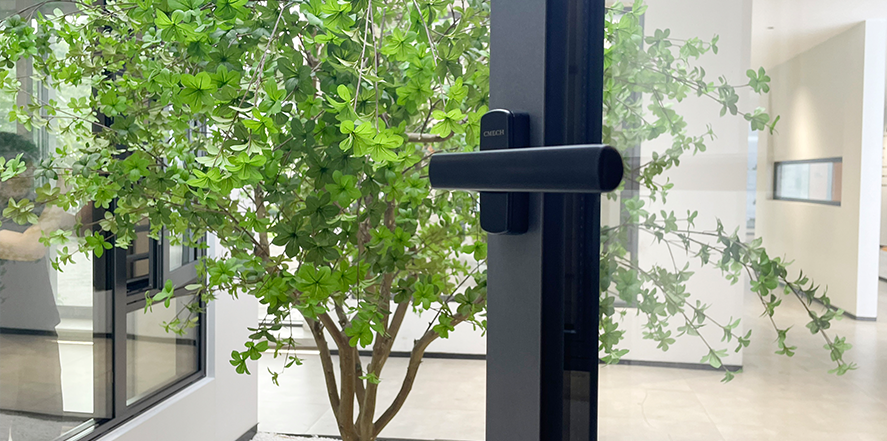


A facade leak rarely begins with a hole. It often starts where a casement sash closes unevenly, leaving a gasket section lightly compressed while another carries excess pressure. The latch, drive, hinge, and frame share a problem: air pressure follows the weakest contact route, and repeated operation gradually makes that route easier to reopen.
The latch can maintain a seal only after the hinge and drive have brought the sash into the right position. CMECH brings those parts together in its casement window hardware configurations, allowing fabricators to evaluate the complete closing sequence against the facade’s sealing requirements.
The Closure Path Begins At The Latch
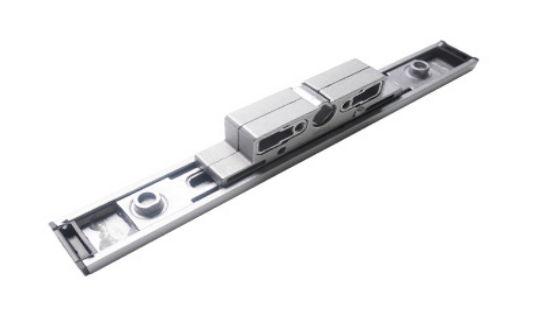
A casement sash closes when handle rotation becomes movement along the drive. The spindle gearbox transmits torque, locking elements travel toward their keepers, and the sash is drawn against the frame. The latch is part of a force path: it does not create sealing, but positions the sash so the gasket can react against the frame around the opening.
If the keeper sits out of line, the latch may engage after the sash has shifted. That creates a local pressure peak near one corner and a weaker contact area elsewhere. Air leakage follows the weaker route because pressure is distributed through the facade, while the overloaded corner increases handle torque and can accelerate wear at drive and fixing interfaces.
Casement window hardware performs better when each component has a defined mechanical role. The hinge supports the sash and controls its approach, the drive transfers rotation, and the latch maintains closure after the handle stops. The consequence is a more repeatable seal line, giving installers a baseline for testing instead of relying on feel alone.
How Does A Latch Create Reliable Facade Airtightness?
Air-tightness depends on compression continuity. A gasket seals only where the sash presses against it with enough, reasonably even deformation. The latch contributes by holding the final position created by the hinge and drive. When the locking point engages at the intended distance, the gasket remains compressed through the perimeter instead of opening at a pressure-sensitive corner.
La ferrure de fenêtre à battant configuration uses a spindle drive gearbox and locking elements to distribute closure around the sash. The gearbox converts a handle turn into controlled travel, while the latch keeps that travel from relaxing under normal vibration and pressure changes. This is why the mechanical check is contact sequence, not handle resistance alone.
A practical commissioning test follows the path in order. Confirm that the sash approaches the frame without rubbing, verify keeper engagement, inspect gasket contact at corners and meeting lines, then check operating torque. If torque rises before the latch engages, geometry may be wrong. If the latch engages but contact remains uneven, investigate hinge position, profile straightness, or gasket seating.
Variables That Decide The Sealing Result
The first variable is the distance between the spindle drive gearbox and each keeper. That dimension controls how much handle rotation becomes useful locking travel. The second is sash geometry, including width, height, glass mass, and profile stiffness. A larger sash can change leverage acting on the latch and shift compression away from the intended sealing line.
Material and fixing also matter. The product configuration uses a high-grade zinc-alloy spindle gearbox, while the friction hinge uses 304 stainless steel with a thickened 4 mm load-bearing arm. The gearbox is tested to 30,000 open-close cycles, and the hinge supports up to 60 kilograms. These details influence how closure alignment behaves after operation and exposure in service.
For coastal apartments or high-rise retrofit floors, review wind demand, drainage, gasket type, keeper position, and access for adjustment together. Window hardware should be selected as a system; door hardware uses a different load path and is not a direct reference. The selection rule is to match latch travel to sash geometry before approving bulk quantities for production on site.
The Coordinated Outswing Casement Hardware Solution For Commercial Retrofit Projects
Consider a coastal apartment project where fabricators must maintain a clean exterior sightline while meeting a documented facade sealing target. The configuration needs a base-free or low-profile handle option, controlled drive travel, corrosion-conscious support parts, and enough adjustment access for installers to verify every opening before interior finishes conceal the frame.
La ferrure de loquet de fenêtre battante Solution combines Milan or Venice Series handles, a one-piece stainless steel handle structure, spring-loaded steel-ball positioning, a triangular fixation structure, zinc-alloy bidirectional spindle drive gearbox, locking elements, and a 304 stainless steel C-groove friction hinge. This arrangement is intended for outswing casement windows where coordinated locking helps maintain consistent gasket contact around the sash.
For screening, the published range runs from 300 to 750 mm in sash width and 300–1,800 mm in height, with load-bearing up to 70 kg. Verify the profile, keeper layout, and sash load before treating it as approval. The engineering verdict is to choose this coordinated solution when the profile, keeper layout, and sash load are verified; isolated latch replacement fits only when existing drive geometry and gasket contact have been measured and retained in the field.
Airtightness Still Depends On Installation
A practical facade inspection starts with a sash that approaches the frame without rubbing. From there, check keeper engagement and gasket contact along the full perimeter; a tight latch at one point offers little information about compression at the opposite corner.
For the coastal retrofit described above, preserve the verified keeper settings and closing checks in the installation record. Profile accuracy, glazing support, gasket condition, and drainage remain part of the facade design, while the latch holds the aligned sash in its final position.


 English
 Arabic
 Chinese
 French
 Thai
 Vietnamese