



Replacing casement hardware in a commercial building is rarely a simple swap. Existing profiles, glazing weight, groove dimensions, and hinge positions were designed as one working assembly. When a replacement component changes the force route, the window may close today yet develop rubbing, leakage, or fastener stress after operation, wind exposure, and seasonal movement.
À CMECH, we approach casement window parts through compatibility first. Our engineering team checks how the handle, spindle drive gearbox, friction hinge, locking elements, and sash profile exchange force during opening and closure. For global B2B sourcing, that method helps distributors and fabricators replace worn hardware without losing the original window’s operating logic.
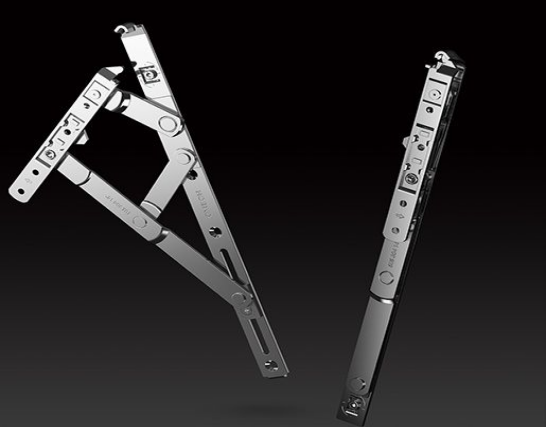
Retrofit Begins With The Existing Force Path
An outswing casement sash loads its hinge like a lever. Glass weight pulls downward, wind presses across the panel, and the opening edge magnifies the reaction around the supported side. The friction hinge guides that movement while the drive gearbox converts handle rotation into locking travel. A retrofit succeeds when the new parts preserve these relationships inside the existing profile.
If a replacement hinge sits slightly out of position, the sash can rotate around a new axis. That shift moves load into fasteners, keepers, and gasket contact. The handle may feel tight because it is correcting geometry rather than simply driving the lock. Over time, uneven stress can enlarge clearances and create service symptoms unrelated to the original replacement.
This is why casement window parts should be evaluated as a load path rather than as interchangeable catalogue items. The useful engineering question is not whether a component resembles the old one, but whether it supports the same sash, accepts the same groove, and returns force to the frame through the same structural interfaces during operation.
What Makes A Replacement Part Fit The Existing Load Path?
Fit begins with measurable interfaces. Confirm sash width and height, glass mass, profile groove, hinge position, spindle center distance, handle geometry, and keeper locations before selecting a replacement. These dimensions determine how far the operating force travels and where the sash reaction enters the frame. A visual match cannot reveal those mechanical relationships reliably during retrofit work.
For an outswing replacement, we start from a published envelope of 400–750 mm sash widths, 300–1,800 mm heights, and load-bearing up to 60 kg. Use these values to screen the replacement schedule, then verify the existing profile, glazing, reinforcement, and fixing depth for each project.
For a global order, document the interface before approving quantity. A distributor can standardize a part number, but the fabricator must confirm that the gearbox center distance and hinge geometry match the installed window. When those checks pass, casement window replacement parts can restore the intended force route; when they fail, a visually similar item may introduce new adjustment problems.
Global Sourcing Depends On The Right Variables
Commercial retrofits often combine several building phases, so the same project may contain different sash sizes and profile generations. The sourcing decision should therefore separate common components from configuration-specific ones. Handle style may be standardized across floors, while spindle length, hinge load, opening angle, and locking layout may need to follow each window family.
Material and test data help narrow the field. The Master Series configuration uses a 304 stainless steel friction hinge with a thickened load-bearing arm and a zinc-alloy spindle drive gearbox. The gearbox is tested for 30,000 open-and-close cycles and offers bidirectional anti-drift adjustment. These details matter because corrosion exposure, repeated torque, and calibration affect the cost of keeping a retrofit serviceable.
The selection rule is to source the operating configuration where the existing window is documented, then isolate only the parts that are proven compatible. Casement window replacement parts are appropriate for a phased program when profile, load, and drive interfaces remain consistent. If records are missing, a field survey and sample-window validation should precede the bulk order across all elevations.
The Master Series Configuration For Commercial Replacement
Consider a regional office retrofit in which contractors must replace worn outswing hardware floor by floor while preserving the aluminum profiles and interior handle appearance. The replacement configuration needs controlled adjustment, dependable support, and a clear commissioning method so each installed window can be checked before the next batch is released across the building.
La casement window replacement parts configuration combines a handle, spindle drive gearbox, locking elements, and a C-groove friction hinge for an outswing casement assembly. At CMECH, we pair the 304 stainless steel hinge with its thickened load-bearing arm and zinc-alloy gearbox, using the published sash range as the starting point for retrofit review and field calibration.
The product data gives the buyer a defined technical boundary rather than a generic promise. Choose this coordinated configuration when the existing groove, sash dimensions, load, and drive geometry are confirmed. Choose isolated replacement parts only when the original assembly has been measured and the installer can verify keeper engagement, gasket contact, handle torque, and drainage after fitting before approval.
Replacement Decisions Should End With Verification
At CMECH, we treat casement window replacement parts as a controlled engineering change, not a visual substitution. The useful sequence is to document the installed window, match the load path, validate one sample, and then release the quantity needed for the wider retrofit program with clear fit records.
Casement window parts cannot remove the need for profile matching, glazing assessment, fastening checks, drainage review, and correct installation. Our selection rule is simple: approve the replacement only after the complete sash and its operating interfaces have been verified together in the field under normal operating conditions.


 English
 Arabic
 Chinese
 French
 Thai
 Vietnamese