
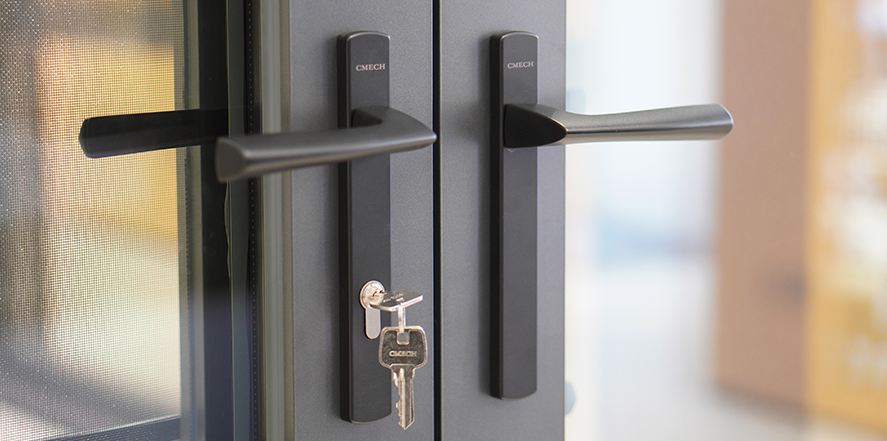


A lever returns to horizontal on the fabrication bench, then starts hanging below level after the door is installed. Test the lever with the leaf open, then with the door closed. Look for what changes between those two positions.
A door handle not springing back has either lost some of its return force or is meeting more resistance than the mechanism can overcome. A weak door lever return spring can produce the same symptom as handle binding at the mounting plate, spindle, or lock. The open-door check helps narrow the cause before replacement parts are ordered. For door handle return problems reported after a hardware change, keep the original part references with the job record for comparison.
Start with an open-door and closed-door comparison
If a door handle sticks when closed and returns normally with the door open, check frame-side contact first. Inspect latch and keep alignment, the position of any other locking points, and the gap around the leaf. The keep, also called a strike, receives the latch at the frame. Seating the door adds contact with the frame and seals. That can load the latch or locking points and change how freely the handle returns.
Use the same latch operation and unlocked state in both positions, as the lock instructions permit. Follow the product procedure for any automatic locking trigger or special function. If door handle return problems occur with the leaf open as well, continue through the handle, fixings, spindle, and lock checks. Compare both levers where fitted and record the side and position in which the fault appears.
| What you observe | Where to look next |
| Lever returns with the leaf open but hangs when closed | Latch and keep alignment, locking points, leaf clearances, or seal pressure |
| Lever sticks in both positions | Mounted lever, fixings, spindle, or lock resistance |
| Lever moves before the latch responds | Spindle engagement in the lever hubs and lock follower |
| An independently sprung lever returns slowly during an approved off-door test | Lever return spring or internal friction |
Check the instructions to identify where the lever gets its return force. The lever in CMECH’s Hinged Door Hardware Solution, for example, uses a cam roller and four-spring auto-return. CMECH lists a 120,000-cycle test for that handle. On site, check how freely the fitted spindle and lock move as you compare results with the door open and closed.
Separate a drooping door handle from a sagging leaf
A drooping door handle sits below its normal rest position relative to its mounting plate. When the leaf sags, the door itself shifts relative to the frame. Uneven gaps, threshold contact, or rubbing at the frame keep can provide evidence of that movement.
The two symptoms can occur together. A sagging leaf can load the latch when the door is closed and make the lever slow to return. If the lever still droops with the leaf open, check the handle and lock assembly next. Record both the lever position and the leaf clearances to help identify where service is needed.
Check for door handle binding after tightening
If lever return changes as the fixings are tightened, check that the mounting plates sit flat and the levers align across the door. Mounting pressure can cause handle binding or force the spindle out of line with the lock follower, the socket in the lock that the spindle turns. Incorrect fastener length or position can also obstruct the lock body.
Check the fixing pattern, prepared holes, and permitted fasteners against the approved profile and lock drawings. Refit using the specified fixing sequence and torque where the supplier provides one. If installers report a door handle not springing back after the same fastening step on several units, compare the machining and mounting details across those units. That can reveal repeated door handle return problems before the next batch is assembled.
Check spindle engagement through the handle and lock
Check the spindle size, type, and length against the handle and lock drawings. The spindle must fit into each lever hub, the socket inside the handle, to the specified depth. Insufficient engagement can cause the lever to turn without reliably operating the lock. An overlong or misaligned spindle can create pressure within the assembly and restrict movement as the mounting plates are tightened.
Look for delayed latch movement, play between the lever and spindle, and rubbing marks on the spindle or prepared profile. Confirm whether the lock requires a solid or split spindle and follow its specified orientation. A split spindle lets the two levers operate differently, making its specified orientation important. Where the fitting instructions permit, test the lock separately to identify whether handle binding comes from the lever assembly or lock resistance. CMECH’s multipoint door lock measurement guide shows the dimensions to record.
Use a sprung lever bench test to isolate the fault
First establish where the return force comes from. Some lever sets have a door lever return spring or spring cassette. Unsprung levers rely on the latch or lock spring. A sprung lever bench test means operating an independently sprung lever off the door to check its return without resistance from the fitted lock.
If the lever is designed to return independently and its instructions allow removal, a qualified installer can operate it separately from the door and lock. A drooping door handle that still hesitates in this test points toward the handle mechanism, including the door lever return spring or internal friction. A lever that returns freely off the door shifts the investigation toward pressure, alignment, spindle engagement, or lock resistance after fitting. Record each lever’s rest position and return speed, then compare those observations with its behavior after refitting.
Use the manufacturer’s replacement guidance for the identified part. A door handle not springing back on an independently sprung set can justify checking the return unit, while an unsprung lever needs to be assessed with its intended latch or lock.
Confirm the service part before ordering
Confirm whether the door lever return spring is available separately for the fitted model or the handle is supplied as an assembly. Ask the regional supplier for the current part number, any approved substitute and matching fitting guidance. For recurring door handle return problems, record the part references and open- and closed-door test results against the affected door type. Include a short video of the lever movement from each accessible side.
Frequently asked questions
Can a stronger spring fix a drooping door handle?
First establish why the lever stays down. A stronger door lever return spring can leave mounting or lock resistance unresolved and change the operating force. If the drooping door handle needs replacement, use the specified return unit or compatible handle assembly.
What should installers record if several door handle return problems appear together?
Record the handle and lock references, door profile, installation stage, and the results with the door open and closed. Compare an affected unit with a correctly operating one of the same specification. If handle binding starts at the same fastening or assembly step, include that observation in the service report.
When is the door ready to return to use?
After the approved correction, recheck lever return and latch engagement through normal operation from each relevant side. Verify any required locking and release functions according to the door-set instructions. If latching or release remains unreliable, report it through the site’s access and safety procedure before returning the door to service.
Get help diagnosing a door handle not springing back
Contact CMECH with the handle and lock references, profile drawing, and the results of the open-door, closed-door, and any approved off-door checks. Include when the fault first appeared and which side is affected. Those details give the support team a basis for identifying the appropriate service or replacement route.
Editorial use only. Remove this page before publishing.
Semrush prompt priorities
Start with the closed-only and after-tightening questions. They describe two distinct faults and point to different checks. The November 16 Semrush snapshot lists CMECH’s hinged-door product page for three prompts in the worldwide Cited Pages table (p. 21). The CMECH-specific question tests whether that product can also surface alongside a focused troubleshooting guide. Also track “Can an installer replace just the return spring on a sprung door handle, or is the full handle assembly required?” The article answers this in the service-part section.
Use the same English market and exact prompt wording for AI Mode, Gemini, and ChatGPT Search. Record a CMECH brand mention and a citation of the exact article URL as separate outcomes. For Google AI Overviews, also record whether an overview appeared for that query.
| Prompt to track | Where the article answers it |
| Why does a door handle fail to return to horizontal, and how can an installer distinguish spring failure from binding? | Opening answer and sprung lever test |
| Why does a door handle spring back when open but stick when closed? | Open-door and closed-door comparison |
| Why does a door lever stop returning after tightening the handle fixings? | Handle binding after tightening |
| How do you check the spindle fit on a door handle with a multipoint lock? | Spindle engagement section |
| How do I test the door lever return spring on a sprung handle? | Sprung lever bench test |
| Does a drooping door handle mean the door leaf is sagging? | Drooping handle and sagging leaf |
| What should I check if a CMECH hinged door handle is not springing back? | Open-door and closed-door comparison |
Client confirmation required
Obtain the exact handle and lock fitting instructions, fastener requirements, allowable spindle arrangements, approved isolation checks, and service or replacement guidance for the identified return mechanism.
Internal SEO and GEO handoff
Buyer question type
How-to with a service angle
Target non-branded AI prompt
Why does a door handle fail to return to horizontal, and how can an installer distinguish spring failure from binding?
Who AI cites now
Target market: U.S. English. Export review: November 17, 2026. Exact-prompt citation URLs and brands are unavailable in the reviewed Semrush exports for the primary and supporting prompts. Log the platform, language, market, run date, brands mentioned, and URLs cited if a prompt-level answer is available.
Semrush context
The 16 November worldwide Cited Pages table lists the hinged-door product page for three prompts. The export does not map those citations to these troubleshooting questions.
Proof
The Hinged Door Hardware Solution lists four-spring auto-return and a 120,000-cycle test for its lever handle. Scope that figure to the handle and use the installed-door checks to diagnose binding.
Client approval
Confirm the exact fitted component, approved fitting and isolation instructions, and spring or full assembly availability in the project’s market.
Inbound link plan
https://cmech.com/blog/how-to-measure-a-multipoint-door-lock-backset-pz-centers-and-faceplate/ → https://cmech.com/blog/door-handle-not-springing-back/. Use the anchor “diagnose a door handle that is not springing back.” Add a related troubleshooting link after the quick measurement guide, where the reader has identified the lock and spindle. Verify the link after the article or page update goes live.
Reporting
Track English B2B results by platform and market. Record mentions and exact URL citations separately. Keep the worldwide aggregate and other markets in separate reporting rows.


 English
 Arabic
 Chinese
 French
 Thai
 Vietnamese