
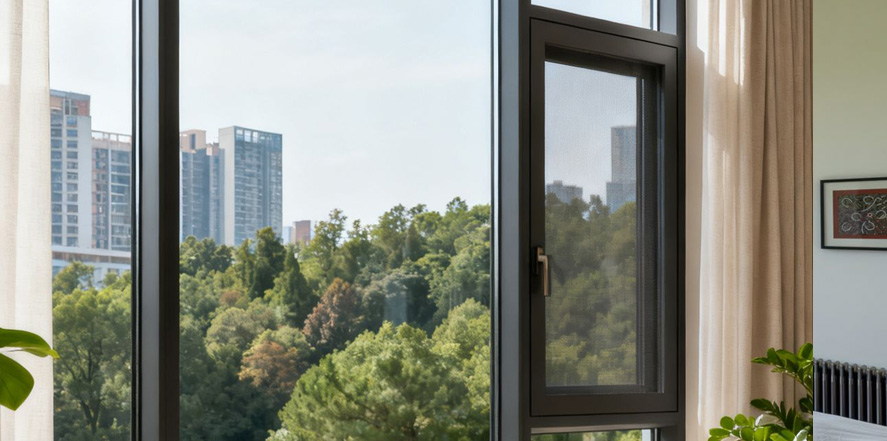


A casement sash rarely fails because one component stops working. More often, small errors in hinge position, gearbox travel, or locking alignment redirect force into the frame and fasteners. Over time, that altered load path can produce rubbing, uneven gasket compression, and structural movement that routine cleaning alone cannot resolve in service.
A calibrated assembly gives each part a defined job: the friction hinge supports the sash, the drive gearbox translates handle movement, and the locking points bring the frame into contact with the seal. CMECH considers these relationships during selection so that later adjustment corrects the cause of misalignment rather than masking it.
Calibration Controls The Force Path
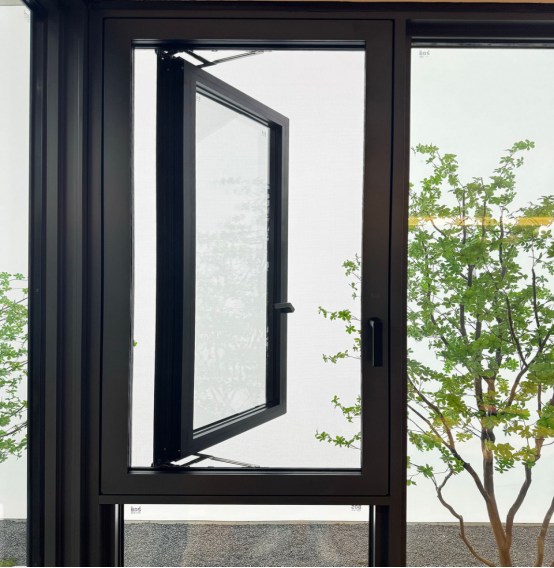
An outward-opening casement sash behaves like a lever attached along one edge. Glass weight pulls downward, while wind pressure acts across the panel. The friction hinge supports and guides that movement; the gearbox converts handle rotation into linear drive; locks then draw the sash toward the frame. Calibration keeps these reactions aligned with the intended profile and fastener positions.
When alignment drifts, the distribution of forces across the hardware and frame can also change. A sash that sits low may press harder on one corner, increasing friction there while reducing contact elsewhere. The handle then requires more torque, the locking bars meet keepers unevenly, and fasteners receive fluctuating loads. That sequence can enlarge clearances and make later adjustments less predictable on site for technicians during commissioning.
For buyers, calibrated casement window parts mean more than tighter manufacturing tolerances. They establish a repeatable relationship between support, drive, and closure. The engineering consequence is practical: a corrected sash can operate with less binding, preserve more even seal contact, and transfer recurring loads through the profile instead of through improvised service corrections during routine service in occupied buildings.
Why Does Adjustment Protect The Sash?
Adjustment works by restoring geometry, not by forcing a resistant window shut. First, the hinge or load-bearing element establishes the sash position. Next, the drive gearbox and locking points are aligned so the handle rotation follows the intended travel. Finally, the keeper engagement and gasket contact are checked across the perimeter, where small errors can otherwise become concentrated stress.
The Master Series page describes a spindle drive gearbox with bidirectional anti-drift adjustment and a 12.5 mm range. That movement allows the drive position to be corrected without treating the handle as a structural brace. In các bộ phận của cửa sổ mở quay, adjustment therefore changes where force is delivered, which can reduce rattle and keep closure action consistent after installation or service. This is the key maintenance benefit.
The useful rule is to adjust in the direction of the observed defect while checking the whole sash after each change. Raising one corner can alter lock engagement on the opposite side; moving a drive point can change handle torque. A calibration record should therefore connect each adjustment to sash geometry, seal contact, keeper engagement, and the final operating test.
Published Limits Define the Selection Boundary
Calibration cannot make an unsuitable sash suitable. Width, height, glazing mass, profile stiffness, reinforcement, and fixing depth determine the reactions reaching the hardware. A compact sash with heavy glass may load its hinge differently from a larger but lighter panel. The correct selection begins with the complete window configuration, then uses component data to screen feasible combinations.
The specified configuration accommodates sash widths of 400–750 mm and sash heights of 300–1,800 mm, with a maximum stated load-bearing capacity of 60 kg. It also identifies 304 stainless steel for the friction hinge and zinc alloy for the spindle drive gearbox. These figures describe an application envelope; they do not replace profile calculations or site-specific fastening checks.
Material choice affects how calibration holds over time. Stainless steel supports corrosion resistance in the hinge, while a zinc-alloy gearbox provides a rigid drive housing for handle torque. Yet finish, drainage, compatible fasteners, and exposure remain part of the decision. Window hardware should be selected as a matched operating system, not as unrelated pieces gathered after the profile is fixed.
The Master Series Casement Configuration In Projects
For a mid-rise residential retrofit, the fabricator may need to preserve existing sightlines while replacing worn operating hardware. The product configuration must fit the C-groove, accept the available handle position, and leave room for setting and inspection. A calibrated arrangement helps the installer distinguish a profile problem from a hardware adjustment problem before repeated units are released.
Việc các bộ phận của cửa sổ mở quay configuration uses a handle, spindle drive gearbox, friction hinge, and locking elements for an outswing casement assembly. At CMECH, we specify the 304 stainless steel hinge with its load-bearing arm and the zinc-alloy gearbox around the published sash range, while the fly-screen option is selected according to opening and maintenance access for occupied units.
The page reports more than 30,000 open-and-close cycles for the gearbox and up to 60 kilograms of hinge support. Those numbers are useful when comparing a bulk distributor order or retrofit schedule, but the verdict is conditional: use the coordinated configuration when sash geometry and profile compatibility are confirmed; use isolated replacement parts only when the original load path and groove dimensions are documented.
Calibration Supports Service Life
Longer service begins with an accurate baseline. Once the sash is glazed and adjusted, record hinge settings, gearbox position, closing effort, and seal contact; those measurements let a technician compare later changes with the original installation rather than replacing parts on appearance alone.
Calibration cannot replace correct profile matching, glazing assessment, secure fixing, effective drainage, or proper installation. Our selection rule is simple: verify the complete sash first, then set the hardware so operation, locking, and perimeter sealing agree with that physical configuration before handover.


 English
 Arabic
 Chinese
 French
 Thai
 Vietnamese