
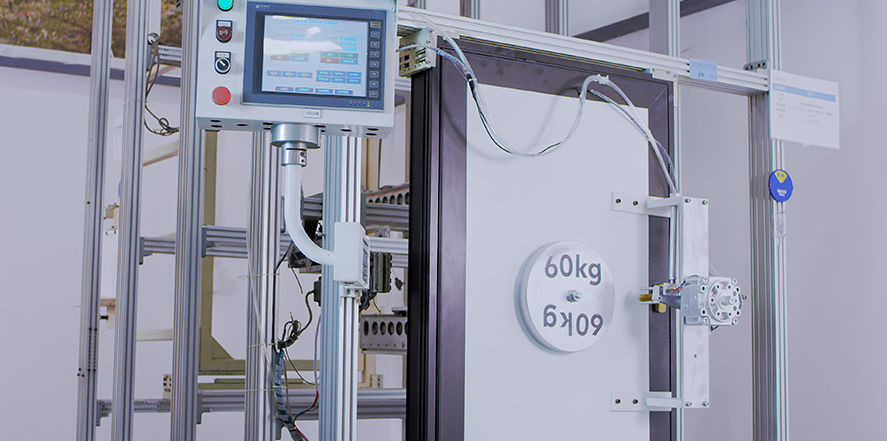


A supplier might quote 30,000 opening cycles, while another offers a report from an environmental chamber. Neither figure tells a specifier much until the tested item and conditions are clear. Was the sample a gearbox, hinge, complete hardware set or finished window? Was it operated during heat exposure? What was checked afterward?
Effective window and door hardware testing uses different equipment for different questions: controlled chambers for temperature or moisture exposure, and operating rigs for repeated movement. The useful evidence is a report that identifies the exact specimen, test conditions, sequence, result and any maintenance or adjustments. A test figure becomes relevant to procurement only when those details match the proposed application.
Quick review guide
- Choose temperature evidence that reflects the project’s exposure and identifies whether the sample was tested as a component or assembly.
- Choose operation evidence that covers the relevant opening and locking sequence, not just an isolated movement.
- Verify the sample reference, dimensions, load, fixings, conditions, inspections and final function in every report.
- Request separate finished-window or finished-door evidence when the project requires air, water or structural performance.
Start with what the test is meant to prove
A test should answer a defined question. High-temperature testing can reveal changes in materials or operation under specified temperatures. Moisture exposure can help assess a finish or mechanism under specified humidity. Repeated-operation testing examines whether a moving part or assembly continues to function through a defined sequence.
These methods are complementary. Hardware durability testing under repeated movement does not, by itself, show how that hardware behaves after moisture or temperature exposure. A controlled thermal cycling test does not automatically demonstrate that a lock will withstand thousands of operations.
Before comparing suppliers, establish whether the evidence covers a component, a hardware arrangement or the complete window or door. A hinge tested on its own and a glazed sash cycled in its frame are different specimens, even if both reports use the word “durability.”
| Test question | Equipment or setup to identify | Evidence to request |
| How does the product respond to changing temperatures? | Temperature-controlled chamber or an apparatus for the specified assembly | Temperature range, exposure time, number of changes, specimen condition and measurements before and after |
| What happens during sustained heat? | Controlled high-temperature exposure setup | Set temperature, duration, sample mounting, observations and post-exposure function |
| How does moisture affect the product? | Controlled humidity chamber | Relative humidity, temperature, duration or cycle profile, visible changes and functional checks |
| Does it continue to operate after repeated use? | Actuated opening, closing or locking rig | Cycle definition, load, speed, inspections, adjustments, failures and final operating condition |
The equipment name alone is insufficient. The table gives the questions a specifier should ask; the selected test method determines the precise procedure and acceptance criteria. A current laboratory accreditation is relevant only to methods within its published scope. A test report records the result for an identified specimen; product certification is a separate assessment. Ask which evidence the project requires.
What should a thermal cycling test show?
A thermal cycling test exposes a specimen to a defined series of temperature changes. For a window or door assembly, the review should establish which surfaces were heated or cooled, how long the specimen remained at each condition and what was measured before and after exposure. Those details matter because the frame, glazing, gaskets, fixings and hardware can respond differently as temperatures change.
A report should state the temperature profile and the location of its measurements. It should also say whether the sample was merely exposed, operated during exposure or tested for function afterward. Without that sequence, “temperature tested” is too broad to support a selection decision.
High-temperature testing answers a narrower question when a sample is held at an elevated temperature for a defined time. It may be useful for assessing a material, finish, lubricant or mechanism under the chosen conditions, but it is not interchangeable with repeated heating and cooling. When reviewing high-temperature testing, ask what the sample had to do after exposure: remain visually intact, retain dimensions, operate correctly or meet another stated criterion.
Temperature evidence for a component also has a different scope from evidence for a finished window. A buyer should match the report to the product and performance requirement in the specification rather than infer assembled-window results from a hardware sample.
What does humidity testing add?
Humidity testing exposes a sample to controlled moisture conditions. Its value lies in the specified temperature, relative humidity, duration and observations—not simply the statement that a chamber was used. A useful report identifies whether the finish changed, moving interfaces showed deterioration or operation changed following exposure.
For a multi-part hardware set, sample selection matters. A visible handle, concealed gearbox, roller and fixing can have different materials and protective treatments. If only the handle underwent humidity testing, the result should not be applied to every other component.
Moisture exposure and salt-spray exposure also address different test conditions. One result should not be presented as a substitute for the other. For projects facing humid or coastal conditions, request evidence for the relevant component and finish, then compare the stated exposure with the project brief.
The final functional check is particularly helpful. If a mechanism was inspected only for appearance, the report may leave unanswered whether it still moves, latches or adjusts as intended after humidity testing.
How does hardware cycle testing work?
Hardware cycle testing repeats a defined movement under controlled conditions. Depending on the product, a cycle might involve turning a handle, driving a gearbox, moving a hinge, opening and closing a sash or operating and locking an entire assembly. The cycle definition must be written down before its count can be interpreted. Hardware cycle testing after environmental exposure also needs a documented sequence if combined effects are the question.
A report should identify the mounted specimen and its load, the travel or opening angle, operating speed, number of cycles and inspection intervals. It should record lubrication, adjustments, replaced parts and any failure. Those details help a manufacturer judge whether the test represents the hardware arrangement it intends to fabricate.
Consider two results both described as “30,000 cycles.” If one counts rotations of a gearbox on a fixture and the other counts complete opening and closing of a loaded sash, they address different questions. Neither figure is automatically a predicted service life or a limit at which the product stops working.
The same principle applies to hardware durability testing after completion. A recorded cycle count is more useful when the report also states the condition of the specimen and whether it remained operable under the specified acceptance criteria.
Read CMECH’s cycle figures at component level
CMECH provides examples of why test scope matters. Its Inswing Casement Window Hardware Solution identifies more than 30,000 opening-and-closing cycles for the hexagon spindle drive gearbox. Its Outswing Awning Window Hardware Solution identifies more than 35,000 opening-and-closing cycles for the friction hinge. They are results attributed to different components, not competing ratings for two complete windows.
That distinction gives a specifier a useful next question. If the project proposes CMECH’s inswing casement arrangement, request the gearbox evidence and identify the accompanying hinge, lock and profile details. For the outswing awning arrangement, examine the friction-hinge evidence alongside the specified sash dimensions and weight. The published figures support a discussion of the named parts; they do not establish the finished window’s air leakage, water penetration or structural result.
CMECH’s laboratory has achieved CNAS accreditation. When a project calls for accredited test evidence, request the current laboratory scope and the report for the selected product or component. Together, those documents show which test was performed and the exact hardware to which the result applies.
Build an evidence package for window and door hardware testing
The most useful window and door hardware testing package lets someone trace a claim from the quoted product to the tested sample. A procurement team can request one schedule covering:
- Product identity: model, component references, revision and finish.
- Test specimen: whether it was a loose component, mounted hardware set or complete glazed assembly.
- Installation: profile or fixture, fixing method, sash dimensions and applied load where relevant.
- Test procedure: method, environmental conditions, cycle definition, duration and sequence.
- Result: observations, measured changes, pass criteria, failures and final operation.
- Interventions: lubrication, adjustment, repair or replacement during testing.
- Applicability: differences between the tested sample and the product proposed for the project.
A complete hardware durability testing file also helps resolve combined exposures. If a buyer wants to know how hardware operates after heat and moisture exposure, reports for three unrelated samples may not answer that question. The evidence needs an appropriate sequence on an identified specimen, with function checked at the relevant stages.
The installation drawing belongs beside the reports. It shows whether the tested or proposed components can be fitted to the project’s profile and operated as intended. Where finished-window performance is specified, obtain evidence for the relevant window assembly as well. These documents answer related, but distinct, questions.
Frequently asked questions
What evidence should a specifier request for window and door hardware testing?
Ask for the test method, complete report, specimen and part references, mounting details, load, conditions, cycle definition, inspections, interventions and final result. For a required accredited test, check that the current laboratory scope includes that specific method.
Is a thermal cycling test the same as high-temperature testing?
No. A thermal cycling test involves a defined sequence of temperature changes. High-temperature testing may instead hold a sample at an elevated condition for a specified period. Read the actual procedure and measurements before treating either result as relevant to the project.
Does humidity testing prove coastal corrosion resistance?
No. Humidity testing and salt-spray exposure use different conditions. Identify the material, finish, sample and procedure in each report, and assess the evidence against the proposed environment.
Does hardware cycle testing establish a product’s service life?
No. Hardware cycle testing records performance through a specified test sequence. The count is evidence about that specimen and method; it is neither a guaranteed number of years in service nor a maximum number of future operations.
Does hardware durability testing prove a finished window is weatherproof?
No. Hardware durability testing does not replace appropriate air, water and structural evidence for the assembled window or door. Check the scope of each report before applying its result to the finished product.
Ask CMECH for evidence matched to your specification
Useful window and door hardware testing begins with the product the project will actually use. Send CMECH the opening type, hardware configuration, profile, sash dimensions and weight, expected exposure and required performance evidence. Contact CMECH to discuss the applicable product drawings, component test reports and laboratory scope for that selection.
Editorial note — do not publish
Client confirmation required: Obtain CMECH’s current accredited laboratory scope and product-level reports before naming any temperature-cycling, sustained-heat or humidity chamber test as a test performed by CMECH. Its public material reviewed here does not identify those specific tests for the products discussed.


 English
 Arabic
 Chinese
 French
 Thai
 Vietnamese