
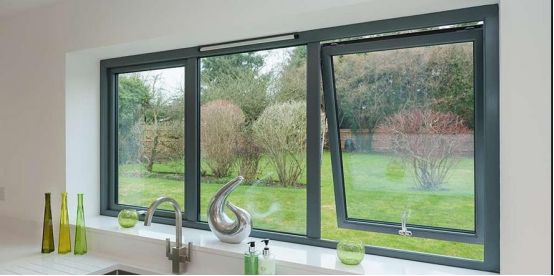


An outward-opening awning sash looks simple until rain, wind pressure, and repeated operation begin working on the same joints. If its hinges, stay, lock, and seals were specified as separate items, small changes in alignment can become hard closing, uneven compression, water paths, and more maintenance calls across a completed building.
For an awning window, reliable operation depends on how the supported sash approaches its frame and how the lock draws it against the gasket. CMECH designs its opening systems around these interacting motions, giving fabricators and distributors a basis for assessing hinge support, limiting travel, and the continuity of the finished seal.
How the Load Path Affects Long-Term Maintenance
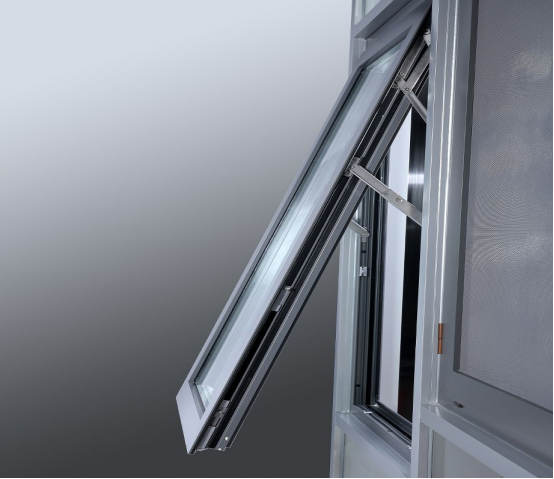
An awning sash is a cantilevered workpiece. Its glass, profile, and hardware create a load, while wind acts on the open panel and creates overturning force. The hinge and limiting stay transfer those forces into the sash and frame. Fasteners and reinforcement then distribute the reactions before they can distort the closing edge through repeated operation and weather exposure.
That route explains why a window can be operable yet be moving toward service trouble. When a guiding component permits sag, the sash rotates slightly about its supported edge. Locking points no longer meet their keepers at the intended angle, so handle torque is spent correcting geometry rather than drawing the perimeter evenly against the gasket at every closing cycle.
Awning window hardware is therefore more than an operator and a hinge. A coordinated hardware system connects sash support, controlled movement, and secure closure, with each component performing a defined function.
How Does Perimeter Compression Work?
Weather sealing begins after the sash reaches the frame, not before. A gasket blocks air and water only when the sash compresses it along the full closing line. If one corner arrives early, the seal there is overloaded while another area remains lightly engaged, leaving a pressure-sensitive route through the assembly during wind-driven rain or repeated pressure changes outside.
A multi-point lock changes this sequence by sharing closure over several positions. The handle turns a transmission, the transmission moves locking elements, and those elements pull the sash toward the frame. In quincaillerie de fenêtre à auvent, that motion should produce progressive, coordinated contact instead of relying on one latch to pull a potentially distorted sash closed against uneven perimeter resistance.
The mechanical lesson is simple: sealing compression is an outcome of geometry and synchronized locking. Excessive compression raises operating torque and can fatigue the gasket; insufficient compression leaves leakage routes. For fabricators, the useful test is whether the sash moves inward evenly as locking proceeds, rather than whether the handle merely reaches its parked position at the end of travel.
How Geometry Determines the Hardware’s Operating Range
Selection begins with the completed sash, not with a single component label. Width, height, glass mass, profile stiffness, reinforcement, and fixing positions determine the reactions the hardware must manage. A window can fall below a published mass boundary yet still create unfavorable leverage if its dimensions move the load farther from the supported edge during real operation in service.
Use published dimensions and load limits as a screening envelope, then verify the assembly. Our Outswing Awning Window Hardware Solution accommodates sash widths and heights from 400 to 2,000 mm, with a published load-bearing capacity of up to 130 kg. These figures provide a starting point for selection, but they do not establish the suitability of every glazing, profile, reinforcement, and fastener combination under project-specific conditions.
Material and finish must be read alongside movement and exposure. Stainless steel may help address corrosion risk, but trapped water, incompatible interfaces, and poor drainage can still create service issues. For this application, awning windows hardware should be selected after the profile section, drainage route, gasket location, opening angle, and access for adjustment have been reviewed through the full operating cycle.
The Coordinated Outswing Awning Window Solution
System selection becomes repeatable when the hardware is specified as a configuration, not a shopping list. The fabricator needs groove compatibility and fastening access, the installer needs adjustment access, and the service team needs a traceable closing sequence. Those practical interfaces connect engineering drawings to field work and make commissioning checks more meaningful for multi-unit project orders at handover.
La awning windows hardware solution combines a stainless steel friction hinge, limiting stay, drive parts, and multi-point lock in standard and curtain-wall configurations. At CMECH, we use this coordinated arrangement for outward-opening awning sashes where the stay guides travel, the hinge supports motion, and the lock distributes closure for resort facades or other wind-exposed specified projects in practice.
Before specifying the system, verify that the proposed sash dimensions, weight, and profile configuration fall within the published application range. That gives a distributor a defined technical conversation, but not a blanket approval. The engineering conclusion is to choose a coordinated system for a new specified assembly, rather than assemble unrelated replacement parts around unverified geometry.
Maintenance Follows The Force Path
Changes in handle effort or gasket contact can be early signs that the hinge, stay, or locking points are no longer working in alignment. A service plan should record these observations against the original configuration so that technicians can identify the affected interface before making an adjustment.
Before releasing an awning window hardware package, confirm sash load, profile compatibility, fastening, drainage, and installation access. During commissioning, follow the sash from guided movement to lock engagement and inspect compression around the perimeter; the resulting record provides a practical reference for later maintenance.



 English
 Arabic
 Chinese
 French
 Thai
 Vietnamese