



A folding door package can contain individual parts and still fail as a system when track, hinge, carrier, and lock dimensions come from unrelated sources. The hidden problem is tolerance accumulation: every small mismatch changes how weight enters the frame, increasing drag, uneven gaps, corrective work during commissioning, and later maintenance burdens.
Procurement teams comparing a turnkey folding package with locally sourced parts need more than a list of individual capacities. CMECH brings the track, rollers, hinges, drives, and locks into one configuration so buyers can check how their interfaces and documentation fit the proposed opening.
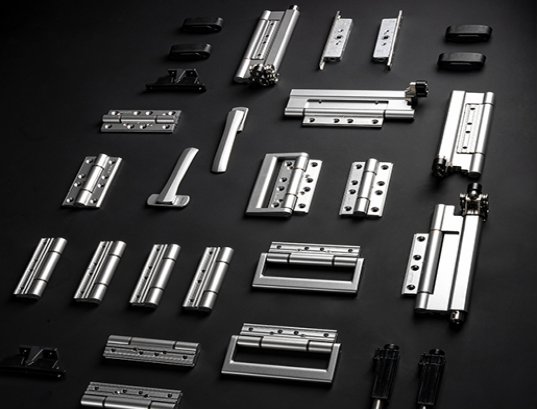
Interface Continuity Controls the Folding Load Path
When a panel moves, its weight travels through rollers, hinges, carriers, and the frame before returning through the track. A turnkey portfolio controls those contact points as one geometry. Fragmented sourcing introduces stacked tolerances, so a roller may enter off-center and force the hinge line to absorb lateral stress that the track was supposed to guide.
The consequence is cumulative. A small height mismatch changes the angle of a leaf; that leaf pushes its neighbor, transferring friction into the next carrier. Door hardware still appears functional, yet force rises and gaps drift. A coordinated bifold door hardware package keeps reference dimensions consistent enough for adjustment to correct installation variation instead of concealing it during routine service.
This is why bifold door tracks and hardware should be reviewed as a load path, not separate line items. A consistent interface reduces the chance that fasteners, guide wheels, or hinge pins become accidental structural substitutes. Window hardware projects often use the same discipline: define the reference plane first, then select components that preserve it through movement, loading, and service access.
Which Procurement Checks Reveal a Fragmented System?
We start by comparing drawing datums for track centerline, hinge axis, roller height, lock position, and panel thickness. If suppliers use different zero points, a nominally matching part can create a field offset. The inspection should record usable adjustment, not only catalog dimensions, because adjustment range determines whether installers can recover a frame deviation without improvising shims.
Đối với phụ kiện cửa gấp đôi, capacity must be checked together with sash width, height, and cycle expectation. A system rated for leaves up to 150 kg is not automatically suitable for every 150 kg leaf; the frame, anchors, glazing, and distribution of mass still govern the actual load path. Certification documents should identify those boundaries clearly for procurement teams before approval.
Consider a six-leaf showroom opening designed for repeated operation. Check each leaf against the 150 kg per-leaf limit and confirm that the complete configuration suits the opening and service conditions. If local parts differ in roller diameter or hinge offset, repeated folding can concentrate impact at one carrier. The result is not merely noise; it can become handle effort, uneven reveals, service calls, delayed handover, exceeding initial component savings.
Adjustment Data Turns Installation Into Verification
A coordinated package gives the installer a sequence: establish track, seat the load-bearing rollers, connect hinges, set the lock and drive, then tune panel gaps. Each step depends on that reference. When parts arrive from unrelated sources, installers often compensate in several places at once, making the final position difficult to reproduce and harder to document during handover to operators.
The adjustment mechanism also reveals engineering intent. The published even configuration uses dual-guide wheels on upper and lower rollers, while the lower roller provides vertical adjustment from -1.5 mm to +3 mm. That range is useful only when track and hinge centers are compatible; otherwise adjustment can move a symptom without restoring a straight, low-friction path through the opening itself.
A project inspection record can include opening force, folded stack alignment, lock engagement, and gap measurements before and after cycling. We compare readings at closed, partly folded, and fully stacked positions because force direction changes as panel centers move. A repeatable record separates a design limitation from a loose anchor or installation error during acceptance testing and service review.
Even Configuration Unifies the Hardware Portfolio
For an airport lounge renovation with a wide glazed partition, the bifold door tracks and hardware from CMECH provide an even-numbered leaf configuration with handles, drive parts, lock parts, load-bearing parts, and accessories for coordinated field installation. The system is specified for sash widths of 500–900 mm, heights of 1,900–3,500 mm, and individual sash weight up to 150 kg.
The lower roller is investment-cast as a single 304 stainless-steel piece, and dual-guide wheels stabilize movement at both roller levels. The design coordinates multi-point locks, shootbolts, adjustable rollers, and hinges, while the lower assembly supports -1.5 mm to +3 mm vertical tuning. Those details make the portfolio auditable during submittal review, commissioning, maintenance planning, and parts verification for facility teams.
For the airport project, that configuration fits because traffic is frequent, panel mass is high, and the opening must fold without blocking circulation. A fragmented local package may fit a residential partition when loads remain modest. Our engineering verdict is direct: choose the certified coordinated system when load, cycle count, and handover accountability are genuinely material project risks.
Portfolio Discipline Improves Long–Term Service
At CMECH, we see turnkey bifold door tracks and hardware as a way to preserve one mechanical language from specification through maintenance. The limitation is important: a coordinated portfolio cannot correct an undersized frame, weak anchorage, excessive glazing weight, or installation outside its adjustment range, so structural calculations remain mandatory.
We recommend bifold door hardware when documented interfaces, capacity, and service responsibility outweigh the apparent savings of fragmented sourcing. Local components may also be considered if their datums, materials, tolerances, and replacement commitments are verified in writing before fabrication.

 English
 Arabic
 Chinese
 French
 Thai
 Vietnamese