



An oceanfront villa asks more from a patio door than smooth travel. Salt aerosol reaches handles, brackets, tracks, and fasteners, while humidity slows drying after cleaning or storms. The mechanical challenge is to preserve load transfer and seal compression as surfaces age, because corrosion can increase friction, loosen adjustment, and turn a beautiful opening into a recurring service problem.
Oceanfront exposure reaches every interface where moisture or salt can collect. ซีเมค specifies the gliding hardware as an assembly of rollers, brackets, handles, drives, and locks, allowing villa designers to consider material selection together with drainage, movement, and access for cleaning.
Corrosion Control Begins along the Load Path
A sliding panel transfers gravity through roller brackets into the track and frame. In a coastal villa, corrosion or salt deposits can roughen contact surfaces, raising rolling resistance and shifting load toward one wheel. The physical consequence is scrubbing and vibration; the engineering consequence is uneven seal contact, higher handle effort, and faster wear at the affected interface.
The gliding configuration supports sash widths from 500 to 3,000 mm, heights above 750 mm, and loads up to 300 kg. Those values establish a design envelope for glazing mass, panel dimensions, and bracket selection. Sliding door hardware should be chosen only after the profile, anchors, track support, and drainage details are checked against that envelope in project documents.
For a villa opening toward a sea-facing terrace, we would inspect the track slope, fastener material, bracket seating, and cleaning access before approving the assembly. Window hardware may share corrosion concerns, but a large sliding panel magnifies small increases in friction. A complete load path keeps movement predictable when wind, salt, and daily use act together.
How Does Material Choice Protect Sliding Movement?
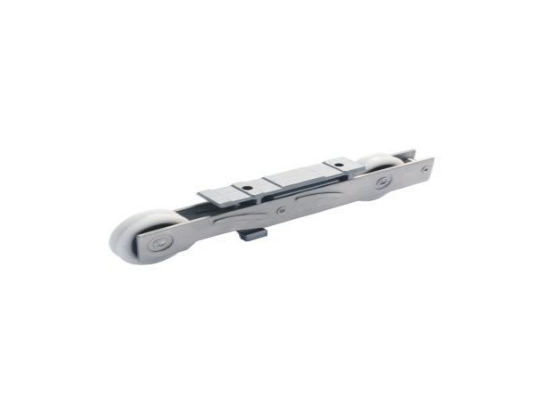
Material selection affects more than appearance because corrosion changes dimensions and surface friction. The sliding roller uses a 304 stainless-steel bracket with a triple-layer adjustable structure, while the wheel has a rubber-coated surface. The cause-and-effect chain is clear: better resistance and distributed load help limit binding, noise, and premature adjustment in exposed openings.
When reviewing อุปกรณ์ประตูบานเลื่อน, we compare bracket material, wheel coating, finish continuity, and access for rinsing or inspection. The roller is specified for loads up to 300 kg and shows minimal wear beyond 120,000 test cycles. These figures support planning, but they do not replace a coastal maintenance schedule or compatible fasteners in practice.
Handle and lock materials also influence service life. The recessed handle uses M-processed aluminum alloy, while the Milan Handle uses high-strength aluminum alloy in a one-piece form. A stable handle reduces wobble and shock at the command point, helping the latch and roller system remain aligned when operators open the door with wet hands or sand on the threshold.
Drainage And Adjustment Keep Seals Working
Coastal sealing depends on keeping water moving away from the track while preserving panel alignment. Height adjustment allows installers to correct the sash after glazing, floor finishing, or seasonal movement. If the panel settles, one corner can compress the gasket excessively while the opposite edge opens a path for spray, dust, and humid air.
We recommend testing the door before finishes, after glazing, and after the drainage route is commissioned. Record start force, running force, stopping position, handle return, and seal contact. If adjustment changes several symptoms together, the bracket is sharing load correctly; if one corner remains abnormal, inspect the profile, track, anchors, and fasteners before changing components.
In oceanfront villas, maintenance access must be designed into the pocket, head, and side clearances. Salt removal may require fresh-water rinsing, visual inspection, and periodic re-lubrication according to the project plan. Sliding patio door hardware can support a refined opening, but only when service teams can reach the parts without damaging finished stone, timber, or plaster.
The CMECH Gliding Configuration Fits Coastal Villas
For a sea-facing villa terrace, the sliding patio door hardware solution from ourcompany combines Milan, Metro, or recessed handles, drive parts, lock parts, adjustable roller brackets, rubber-coated rollers, load-bearing components, and accessories. The roller bracket uses corrosion-resistant 304 stainless steel, while the handle options provide different profiles for large panels, screen sashes, and restrained interior sightlines.
The configuration supports sash widths from 500 to 3,000 mm, heights above 750 mm, and total load up to 300 kg. We would align those limits with glazing mass, profile stiffness, anchor spacing, drainage, and exposure direction. A villa schedule should also document rinsing access, inspection intervals, and replacement references so sliding patio door hardware remains traceable after handover.
Our engineering verdict is clear: use a coordinated gliding system for oceanfront villas where corrosion exposure, large glass, and repeated operation overlap. Simpler sliding door hardware fits sheltered openings or lighter panels where cleaning is easier and more frequent adjustment is acceptable. Integrated components provide a coordinated approach to door movement and hardware adjustment.
Coastal Durability Has Practical Limits
A 304 stainless-steel roller bracket is one element of the coastal specification, not a substitute for drainage or compatible fasteners. After glazing, check operating force and seal contact under load and verify that the track and adjustment points remain accessible.
The villa’s maintenance schedule should identify rinsing access and inspection points after storms or major cleaning. Keeping those records alongside the selected hardware and profile details helps the service team trace changes in movement as the opening ages.

 English
 Arabic
 Chinese
 French
 Thai
 Vietnamese