



Selecting hardware for a casement awning window project requires more than comparing individual components. For architects, window manufacturers, contractors, and developers, the hardware system must match the window profile, sash dimensions, operating requirements, and expected environmental conditions. At CMECH, we recommend evaluating the complete mechanism as one coordinated system, because hinges, stays, drives, and locking points work together to determine security, stability, sealing, and service life.
Start With the Window Configuration
Our first sourcing step is to confirm the opening configuration. Awning windows are typically hinged at the top and open outward from the bottom, so the hardware must support controlled movement while keeping the sash stable. For outward-opening casement and awning designs, buyers should also distinguish between standard installations and curtain wall applications.
The selected system should match the window groove and profile. Compatibility is especially important when replacing existing hardware or standardizing components across several window sizes. A technically strong component can still create problems if its groove or connection geometry does not correspond with the window system.
Evaluate Awning Window Hardware as a System
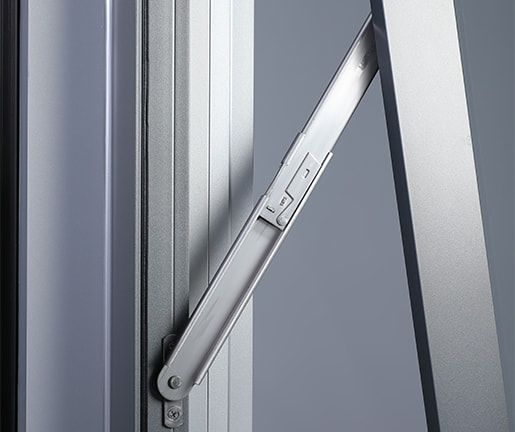
We look at three performance areas when sourcing awning window hardware: movement control, load support, and locking performance. A limiting stay controls how far the sash opens and helps resist sudden movement caused by wind. A friction hinge supports the sash during operation, while a multi-point lock distributes locking action across several points.
CMECH’s outswing quincaillerie de fenêtre à auvent solution combines these functions in one system. The solution is available in standard and curtain wall configurations and uses a multi-point locking mechanism designed to improve security, weather sealing, and overall stability. This approach lets buyers evaluate compatible components together rather than assembling unrelated parts.
Check Material and Durability Details
Material selection deserves close attention in projects exposed to moisture, temperature changes, or frequent operation. For this solution, the limiting stay and friction hinge are made from 304 stainless steel. The limiting stay is available from 8 to 20 inches and locks automatically when opened, helping provide wind resistance and prevent sudden closure.
The friction hinge is offered in C-groove and K-groove versions. Its reinforced support arm is 3.5 mm thick and works with multiple 8 mm solid rivets. The three-arm structure is designed for stability, while testing exceeding 35,000 open-and-close cycles provides a useful durability reference for buyers assessing long-term operation.
Match the Hardware to Project Dimensions
Dimensional compatibility should be verified before purchase. The specified outswing awning system supports sash widths from 400 to 2,000 mm and sash heights from 400 to 2,000 mm, with a maximum load-bearing capacity of 130 kg. These figures help buyers check whether the proposed configuration falls within the system’s stated range.
Buyers should also confirm transmission requirements. The solution offers T-drive lengths of 17, 20, 24, 28, 32, 36, and 40 mm, while spindle drive gearbox center distances are available at 22, 25, 30, and 35 mm. Confirming these details early can reduce compatibility risks in fabrication.
Consider Security, Sealing, and Wind Performance
For commercial and residential developments, casement awning window hardware performance directly influences the window assembly. A multi-point locking arrangement can help create more consistent engagement around the sash, while coordinated transmission components support smooth operation. The system is designed to improve water tightness, air tightness, and wind pressure resistance.
We at CMECH position our hardware systems for architects, designers, real estate developers, and window and door companies. That business focus makes system compatibility, dependable performance, and technical support key sourcing considerations. For projects requiring consistent performance across many window units, specifying a coordinated hardware package can also make procurement and quality control manageable.
Build a Clear Procurement Checklist
Before placing an order, we recommend confirming the window type, profile groove, sash width and height, sash weight, opening configuration, and required locking arrangement. Then verify the exact hardware dimensions, material, available configurations, and transmission interfaces against the window manufacturer’s drawings.
It is equally important to clarify application conditions and installation requirements with the supplier. For larger projects, buyers should request technical documentation and confirm suitability for the intended window construction. This helps prevent a common procurement problem: receiving components that are individually correct but collectively incompatible.
Why a Complete Hardware System Makes Sense
Sourcing casement awning window hardware as a coordinated system can reduce design uncertainty and improve consistency across production. Rather than treating the hinge, limiting stay, and lock as separate purchases, we can assess how each component contributes to the overall window assembly.
CMECH provides a full range of door and window hardware systems and integrated solutions for global markets. For its outswing awning window solution, the combination of 304 stainless-steel components, multiple groove options, defined sash ranges, and coordinated locking performance gives buyers clear criteria for evaluation.
Make Performance the Basis of Sourcing Decisions
A successful casement awning window hardware purchase starts with compatibility and ends with reliable operation. By checking the window configuration, dimensions, material, load capacity, groove type, transmission requirements, and performance objectives before ordering, project teams can make more informed sourcing decisions. For business buyers, this approach connects hardware selection with fabrication efficiency, installation reliability, and project performance.
 English
 Arabic
 Chinese
 French
 Thai
 Vietnamese