



When a distributor replaces hundreds of outward-opening sashes, the order is not a box of handles; it is a load path delivered in repeatable pieces. Casement window hardware must transfer sash weight, resist wind-driven movement, and preserve seal compression while installers match profiles across multiple projects without stopping the site schedule.
在 CMECH, we approach replacement sourcing as a system-matching task, supported by an engineering process that includes 15 categories of dedicated testing. For distributors and fabricators, that approach turns replacement casement window hardware from a purchasing label into a defined assembly with traceable roles.
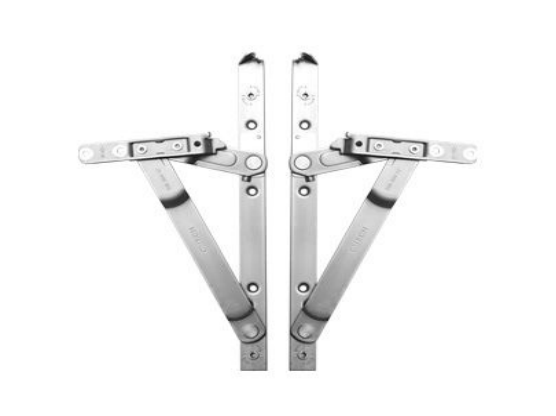
A System Package Preserves Interface Continuity
Closing a casement involves coordinated movement between the handle, drive mechanism, locking elements, and hinges rather than a latch action alone. The handle drives the spindle, the spindle actuates the gearbox, and the gearbox carries motion to locking elements. Those points draw the sash toward the frame, while the friction hinge holds the moving leaf within its designed path during daily use on site.
Systematic packages preserve the relationships among these components. A compatible handle, drive part, lock part, and load-bearing part begin from one dimensional reference, so lock travel and hinge clearance are considered together. When a generic substitute changes spindle center distance or T-drive length, the operator may feel normal movement while the sash closes slightly off-center at the active locking side.
That offset has a physical consequence. A gasket seals when the sash compresses it consistently around the perimeter; uneven locking travel makes one zone tight and another lightly loaded. The lightly loaded zone becomes the first route for air or water under pressure. In repeated installations, this is why component interchangeability must mean measured compatibility instead of surface resemblance alone.
Where Do Generic Substitutes Break Down?
Generic replacement parts most often break down at the interfaces that cannot be judged from a product photograph. The 平开窗五金 specification needs a matching T-drive length, spindle-drive center distance, groove engagement, and sash range. If one dimension differs, fitting may require shims, excessive adjustment, or force at the handle. Those remedies shift uncertainty into the installation crew onsite.
The problem is cumulative rather than cosmetic. A replacement handle with a near-but-not-matching spindle can leave the gearbox short of full stroke. That reduced travel changes the closing force at each locking element. The result can be uneven gasket compression, increased air paths, or local contact that accelerates premature wear at the hinge and locking side during repeated operation.
Generic substitutes have a limited place: a one-off repair can be practical when the original geometry is measured, the sash load is confirmed, and the system is not being represented as a certified configuration. For portfolio replacement, the better engineering choice is a coordinated package because consistent interfaces reduce variation across factories, installers, and later field service calls onsite.
Traceability Turns Procurement Into Repeatable Work
Traceability is what separates a system specification from a list of parts. A buyer should be able to trace the proposed handle, gearbox, hinge, locking elements, and stated sash envelope to one defined project configuration. That makes incoming inspection useful: packaging labels, drawings, and batch records can be checked against the same dimensional and material assumptions before onsite assembly begins.
For a listed outswing configuration, published limits offer a starting filter: sash width 300–750 mm, sash height 300–1,800 mm, and load-bearing up to 70 kg. Those figures do not authorize arbitrary combinations. They tell procurement teams which sashes warrant further profile, fixing, wind-exposure, and drainage checks before purchasing a replacement set for installation at each active project site before ordering.
We also compare specifications with the operating mechanism. A 30,000-cycle gearbox test and a 12.5 mm anti-drift range describe specific parts of the system, not every project condition. They are valuable because they create review points for the buyer. They do not replace checking the profile wall, fastener engagement, glazing weight, or fabrication accuracy during site preparation and approval.
A Defined Outswing Solution Reduces Variation
For a hospital ward renewal, we at CMECH specify the replacement casement window hardware outswing solution: a Milan or Venice Series stainless-steel handle, spring-loaded steel-ball positioning, triangular fixation, zinc-alloy bidirectional spindle gearbox, locking elements, and 304 stainless-steel C-groove friction hinge. Its C-groove friction hinge features a thickened 4 mm load-bearing arm and supports sash loads of up to 60 kg.
The one-piece stainless-steel handle uses rolling spring-loaded steel-ball positioning and triangular fixation, while the gearbox has a 12.5 mm maximum anti-drift mechanism. The 304 stainless-steel friction hinge has a thickened 4 mm load-bearing arm and supports up to 60 kg. These details directly address movement, fixing stability, and sash support across repeated window elevations in larger phased institutional retrofit projects.
We would use this package where the project calls for repeated external casements and controlled handover documentation, such as phased hospital modernization. A generic substitute is unsuitable when its drive dimensions, material construction, and operating evidence cannot be tied to the fully verified listed assembly. The package choice has boundaries: match it to the stated sash range and profile system.
Specify the Whole Operating System
For the hospital renewal, the coordinated package provides a repeatable basis for ordering and checking the same hardware across wards. The benefit depends on matching the published sash envelope and the existing profiles before the first installation is signed off.
An isolated generic component may still suit a single repair when its dimensions, load, and operation have been verified against the original assembly. Record those checks separately from the system package; neither approach removes the need to inspect fasteners, drainage, glazing, and final adjustment.



 English
 Arabic
 Chinese
 French
 Thai
 Vietnamese