
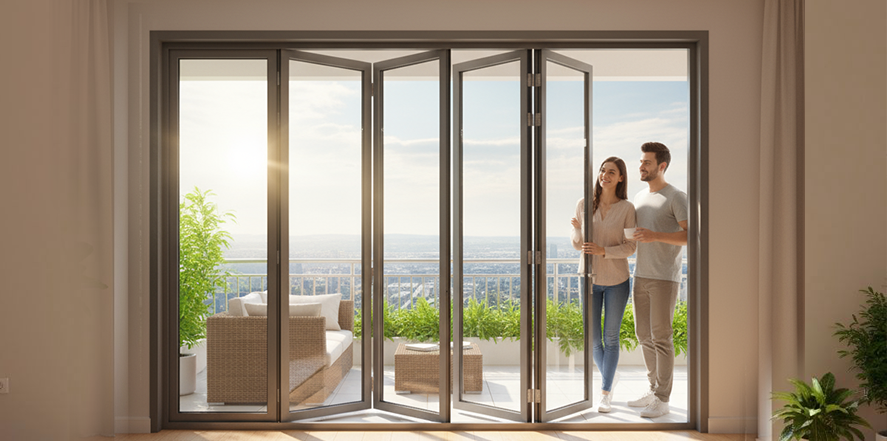


A folded glass wall can look aligned at handover yet begin dragging after seasons of regular use. The usual suspect is not merely a loose screw. Repeated panel weight, uneven hinge clearance, and small dimensional errors can bend a weak load path until closing force rises and the fold line loses rhythm.
Stable folding depends on the way multiple leaves share weight while their hinges rotate and rollers guide the stack. CMECH examines hinge interfaces, casting geometry, roller guidance, and adjustment together, helping specifiers identify where uneven loading could distort the fold line over time.
Warping Starts With an Uneven Force Path
Each leaf transfers gravity from its glazing and frame into hinges, carriers, and the top or bottom guide. When bearing faces are square, that load travels through broad metal sections. If a pin sits off-axis, a narrow edge receives concentrated stress, creating local yielding and progressive clearance during demanding daily cycles across a long service interval.
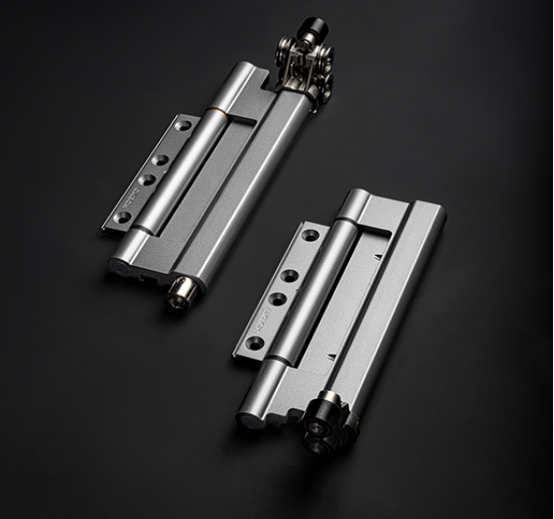
Machining matters because it fixes the relationship among pivot center, screw seat, leaf plane, and roller centerline before installation. A precision hinge body presents repeatable contact surfaces, so fasteners clamp rather than pull parts into alignment. That preserves designed clearances and prevents the hinge knuckle from becoming a lever against its mounting screws when panels change direction repeatedly.
Warpage is often described as a material problem, but geometry controls when material reaches its limit. A 150 kg panel divided through matched carriers and hinges produces lower bending demand than the same mass biased toward one misaligned fitting. Our engineering verdict is clear: specify machined metal bifold door hardware interfaces first, then choose grade and finish for exposure.
Which Tolerances Keep Folding Hinges From Distorting?
Inspectors should measure more than an assembled door gap. They need the hinge-axis position, the flatness of mounting lands, pin-to-knuckle fit, and roller bracket height. These dimensions determine whether the leaf rotates around a stable axis or scuffs laterally as folded panels travel along their guides under changing loads and repeated direction reversals through daily service.
For 折叠门五金, the useful tolerance question is functional rather than decorative: does adjustment recover a small installation variation without forcing a hinge sideways? We look for a controlled range at the roller, repeatable pin seating, and parallel leaves. A loose stack hides error briefly, then transfers it into impact and wear at every closing and unfolding motion.
One practical example clarifies the risk. A four-leaf restaurant partition must be assessed against the system’s specified weight limit, with panel dimensions, alignment, and guide relationships considered during hardware selection. That cyclic side load enlarges clearance, raises handle effort, and eventually makes a carefully fitted opening feel unreliable to users.
Inspection Sequence Reveals the True Load Path
We begin with incoming parts, checking casting or machined surfaces for burrs, porosity, and distorted screw bosses. Next, we gauge pin alignment and confirm that left and right components are correctly paired. This separates manufacturing variation from installation error before glazed panels add load and make a simple hinge correction more difficult for the installer during site adjustment work.
A representative sash can then be installed to assess the full folding motion under controlled conditions. Observers watch the roller entering its guide, the hinge knuckles sharing rotation, and the lock side meeting its strike. Any rising resistance marks a side load; it should trigger measurement, not a heavier handle or extra lubricant, because friction here is evidence rather than a cure.
Cycle testing should include closed, partly folded, and fully stacked positions, because the load vector shifts as panel centers move. Our even-leaf configuration has a stated system durability of more than 30,000 cycles, which can serve as a reference during project evaluation. We would still inspect samples after cycling: endurance data means little if clearance, finish, or adjustment retention drifts under actual site conditions.
Configured Metal Hardware Supports Stable Folding Panels
For hospitality terraces and wide residential openings, metal bifold door hardware from CMECH can be configured as an even-leaf system with handles, drive parts, lock parts, load-bearing parts, and accessories. The published configuration supports panels 500–900 mm wide, 1,900–3,500 mm high, and up to 150 kg per sash for aligned multi-leaf operation when the surrounding frame is suitably engineered.
The lower roller is investment-cast in 304 stainless steel and adjusts from -1.5 mm to +3 mm vertically. Dual-guide wheels at upper and lower rollers control wandering while the hinge line carries rotation. We specify this arrangement when panel weight, frequent traffic, and large glazed areas demand a traceable load route rather than improvised field shimming during installation work.
That is the selection rule: choose metal bifold door hardware with adjustable carriers and machined hinge references when the panel schedule approaches the upper range or tolerances are tight. Simpler folding fittings can suit lighter, low-use partitions, while heavier glazed panels require hardware selected according to verified load limits and installation conditions.
Durability Begins Before the First Fold
Select the roller and hinge configuration against verified panel weight, frame stiffness, anchorage, and the available adjustment range. For the large glazed openings discussed above, record the designed clearances and support conditions before accepting the hardware schedule.
At commissioning, observe the leaves through the complete fold and retain the initial alignment and adjustment settings. Comparing later movement with that baseline helps maintenance teams distinguish a hinge issue from a change in the frame, track, or panel support.


 English
 Arabic
 Chinese
 French
 Thai
 Vietnamese