
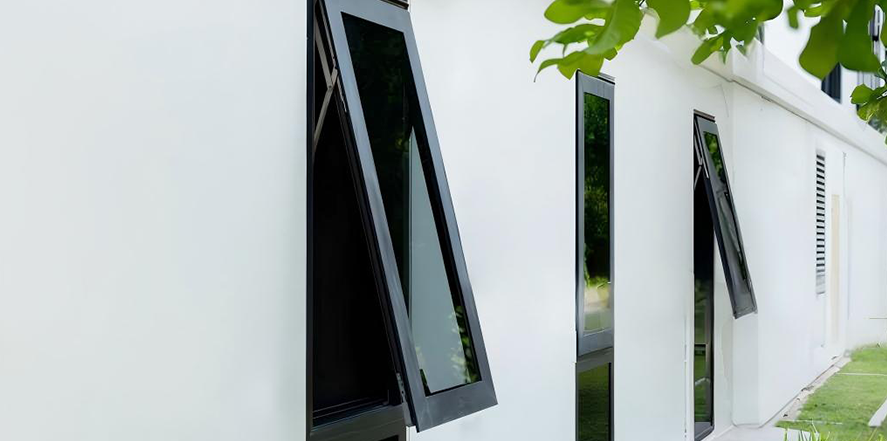


Awning window hardware holds outward-opening sashes at designated positions to support consistent natural ventilation under suitable building and outdoor conditions. Hinges, stays, transmission components, and locking systems govern sash opening, stability, and secure closure.
For architects, developers, designers, and window manufacturers, hardware selection involves more than matching components to a window profile. Sash dimensions, operating geometry, expected loads, fabrication conditions, and the security requirements of the complete window must also be considered.
Coordinated hardware design is essential when ventilation, controlled opening, secure closure, and long-term durability need to function in tandem. Manufacturers such as CMECH develop integrated window hardware configurations in which load-bearing, transmission, opening-control, and locking components work as part of the same assembly.
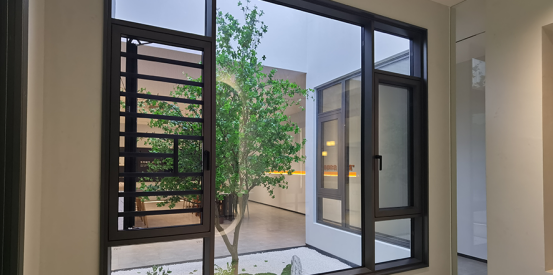
How Does Awning Window Hardware Support Stable Natural Ventilation?
Awning window hardware supports natural ventilation by maintaining the sash at the intended opening position.
Hinges and opening-control components help maintain the sash geometry specified by the ventilation design, while actual airflow depends on environmental and building conditions.
How Do Opening Angle and Geometry Affect Airflow?
Opening angle affects airflow by changing the effective opening area and the path through which air enters or leaves a space.
Real-world airflow also varies with façade orientation, prevailing wind direction, window dimensions, room configuration, indoor-outdoor temperature differences, and nearby buildings or external obstructions.
Ultimately, the hardware’s practical function is to maintain the opening geometry defined by the ventilation design.
When Is Natural Ventilation Most Appropriate?
Natural ventilation is most appropriate when outdoor temperature, humidity, wind, and air quality allow comfortable indoor air exchange.
Because open windows do not automatically filter, heat, cool, or dehumidify incoming air, they should be coordinated with the building’s mechanical ventilation and climate-control strategy.
Project reviews should also consider the intended opening, ventilation strategy, and the hardware’s ability to maintain it. Reliable closure remains important when the same window must meet security requirements.
Which Awning Window Hardware Features Matter for Security?
Awning window security depends on the coordinated performance of locks, hinges, frames, glazing, fixings, and installation.
Multi-point locking engages the sash at several positions around the perimeter, supporting more consistent closure and sash-to-frame contact than a comparable single-point configuration.
However, locking points alone do not determine the security rating of the complete window. Where a defined security classification is required, applicable whole-window testing requirements should be confirmed.
What Role Do Hinges and Limiting Stays Play?
Hinges support and guide sash movement, while limiting stays control opening travel and help reduce uncontrolled movement. Their suitability depends on sash dimensions, glass weight, profile geometry, fixing positions, opening requirements, and expected wind exposure.
Project teams should also verify the maximum opening, locking-point arrangement, hinge and stay capacity, frame and glazing design, and installation requirements. Hardware should therefore be selected for full-system compatibility rather than single-component strength.
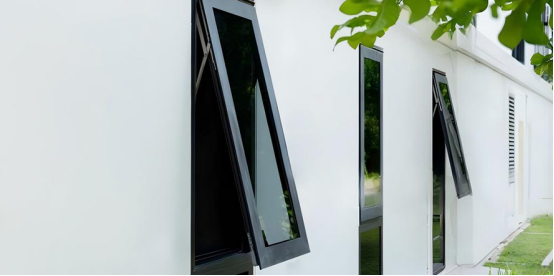
What Should Buyers Look for in an Awning Window Hardware Kit?
Buyers should evaluate an awning window hardware kit as a coordinated set of operating, supporting, restraining, and locking components.
A component may fit the profile physically but remain unsuitable if its load range, transmission dimensions, opening geometry, or locking arrangement does not match the sash.
Which Components Should Be Checked Together?
The main components should be assessed according to the functions they perform within the complete window.
| Hardware Area | Main Function | What to Check | Verification & Compliance Notes |
| Handle and transmission parts | Transfer operating input | Drive geometry and profile compatibility | Confirm installation dimensions |
| قفل متعدد النقاط | Engage sash at multiple locations | Lock positions and alignment | Assess within whole-window security requirements |
| مفصلات احتكاكية | Guide and support sash movement | Profile type, dimensions, and sash load | Verify against actual sash conditions |
| Limiting stay | Control opening travel | Stay length and intended opening | Review expected operating and wind conditions |
| الحراس | Receive locking points | Position and profile compatibility | Confirm engagement after fabrication |
| Frame, gaskets, and glazing | Complete the window envelope | Interface with hardware | Assess sealing and security as a complete assembly |
Dimensional drawings and profile compatibility should be reviewed before fabrication to reduce installation conflicts and ensure compatibility with the finished sash.
How Do Awning, Casement, and Sliding Windows Differ?
Different window types create different opening geometries and airflow paths, so hardware selection should follow the architectural window concept.
| Window Type | Typical Movement | Ventilation Characteristic | Hardware Consideration |
| Awning | Top-hinged sash opens outward | Air passes below and around the projecting sash | Requires controlled sash support and appropriate opening geometry |
| السقيفة | Side-hinged sash opens outward | Sash orientation interacts strongly with wind direction | Requires suitable hinges, locking, and opening clearance |
| انزلاق | Panel moves horizontally | Available opening depends on panel travel | Requires suitable tracks, rollers, and clear opening area |
No window type delivers identical ventilation performance in every building. Hardware selection should therefore follow the window design and actual operating conditions, including intended sash movement, load, opening geometry, and installation requirements.
How Does CMECH’s Outswing Awning Window Hardware Solution Address These Requirements?
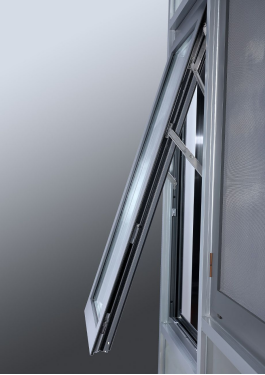
The CMECH outswing awning window hardware solution combines handles, transmission parts, lock parts, load-bearing components, and accessories for standard window and curtain wall configurations.
Its ملحقات نوافذ المظلة includes limiting stays, friction hinges, and coordinated multi-point locking components. Together, these elements allow opening control, sash support, transmission, and closure to be considered within one hardware configuration.
What Are the Main Product Features?
The product documentation identifies several features relevant to project specification:
- Limiting stay
The stay is manufactured from 304 stainless steel and is available in sizes from 8 to 20 inches. It automatically locks after opening and is designed to help reduce abrupt sash closure caused by wind.
The product page does not provide a numerical wind-load rating; suitability should therefore be checked against the design wind conditions of the complete window.
- مفصلة احتكاك
The hinge uses 304 stainless steel and is available for C-groove and K-groove profiles. Its construction includes a 3.5 mm support arm, multiple 8 mm solid rivets, and a three-arm structure.
- Durability testing
The friction hinge has undergone durability testing exceeding 35,000 open-close cycles. A specific ISO standard is not identified for this cycle test. Where formal evidence is required for tender compliance, project teams may request the relevant test report.
- Multi-point locking
The locking structure engages the sash at several positions to provide more consistent closure around the window perimeter.
Product documentation indicates that uniform sash compression can help support water tightness, air tightness, wind pressure resistance, and window stability when the hardware is integrated with the complete window assembly.
These outcomes depend on matching the hardware with compatible frames, sealing gaskets, appropriate glazing, qualified fabrication, and professional installation.
Which Product Specifications Should Buyers Verify?
Published dimensions provide an initial reference for hardware selection, while the final configuration must reflect actual project conditions.
| Parameter | Official Product Range |
| Sash width | 400–2,000 mm |
| Sash height | 400–2,000 mm |
| حاملة الأحمال | ≤130 kg |
| T-Drive length | 17, 20, 24, 28, 32, 36, 40 mm |
| Gearbox center distance | 22, 25, 30, 35 mm |
The published ≤130 kg load-bearing figure should not be interpreted as automatic approval for every sash within the listed dimensional range.
Final verification should account for actual glass weight, aluminium profile construction, hardware configuration, installation conditions, façade wind loads, and applicable engineering requirements.
Conclusion: How Should You Select Awning Window Hardware for a Project?
The right awning window hardware should maintain the required opening geometry, control sash movement, support secure closure, and remain compatible with the complete window assembly.
Selection should consider ventilation requirements, sash weight, glazing and frame conditions, wind loads, security criteria, and applicable test documentation. Hardware should therefore be evaluated against actual operating conditions rather than individual component specifications alone.

 English
 Arabic
 Chinese
 French
 Thai
 Vietnamese