
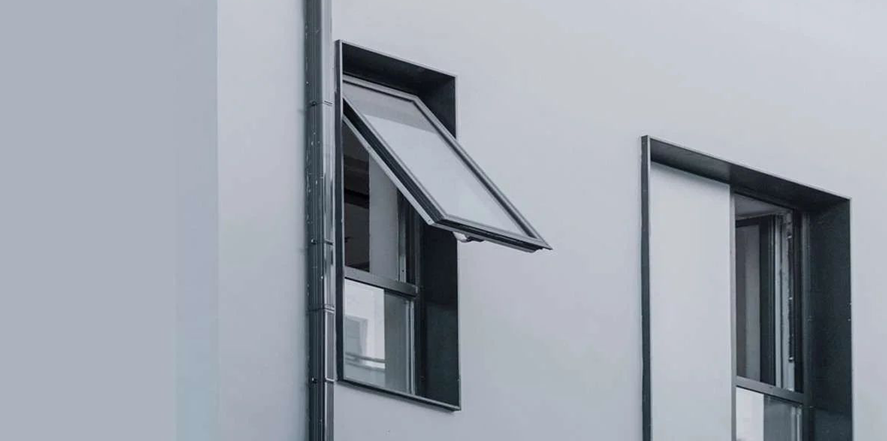


Coastal homes place unusual demands on window systems. Salt-laden air, strong winds, driving rain, and frequent temperature changes can expose weaknesses that may remain unnoticed in ordinary residential applications. When we specify ملحقات نوافذ المظلة for modern coastal projects, we therefore look beyond appearance and basic operation. At CMECH, we focus on how each hardware element contributes to the complete window assembly, especially where the project requires dependable performance under demanding coastal conditions.
Why Coastal Projects Need Purpose-Designed Hardware
Coastal residential windows must manage environmental exposure while maintaining comfortable indoor conditions. Hardware plays an important role because hinges, stays, and locking components control how the sash moves, remains supported, and seals against the frame.
For project teams, this means hardware selection should be made alongside window profile, sash dimensions, glazing configuration, and installation requirements. A visually attractive window can still underperform if the hardware cannot provide adequate support or maintain consistent compression around the perimeter.
We also need to consider wind exposure. An outswing awning configuration can provide useful ventilation, but its moving sash must remain controlled when external forces act on the window. A coordinated system is therefore more appropriate than treating each component as an isolated accessory.
How Outswing Awning Window Hardware Supports Stability
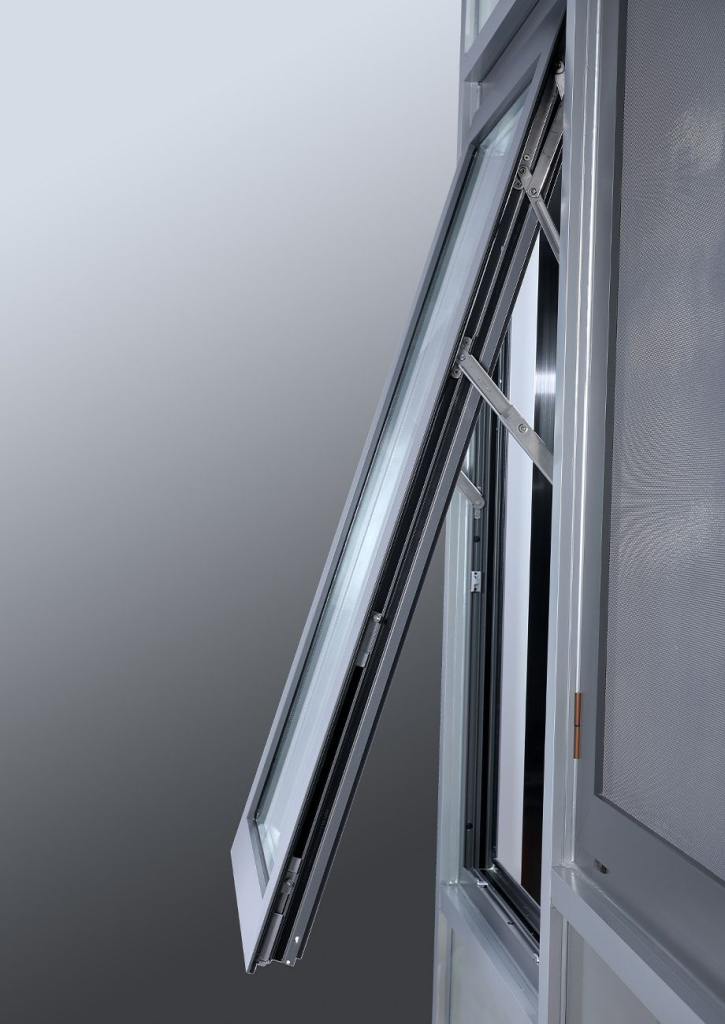
A reliable outswing awning window hardware system should distribute operating and external loads through components designed to work together. In our solution, the limiting stay, friction hinge, and multi-point lock form the core of this approach.
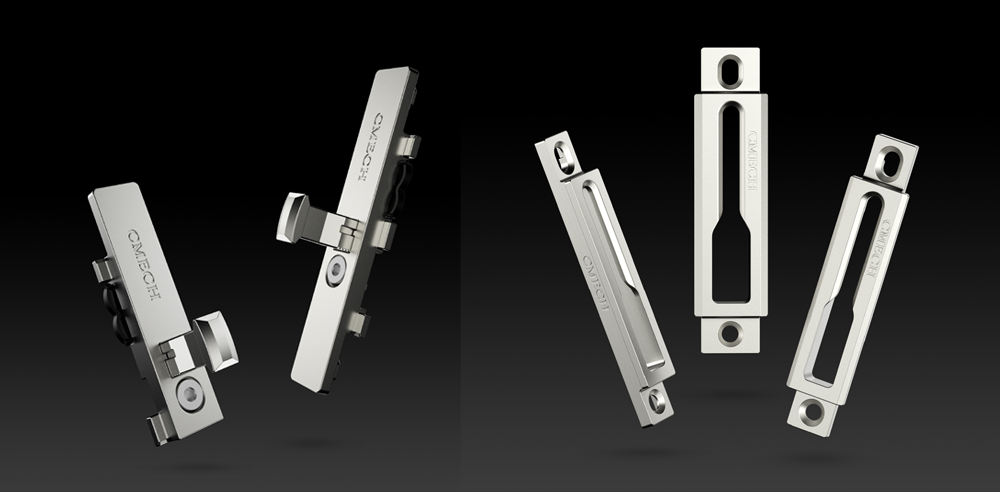
The limiting stay is available from 8 to 20 inches and locks automatically when opened. Made entirely from 304 stainless steel, it is designed to resist sudden closure in strong winds. This gives project designers a practical way to improve sash control while accommodating different window grooves.
The friction hinge is also manufactured from 304 stainless steel and is available in C-groove and K-groove versions. Its 3.5 mm reinforced support arm, 8 mm solid rivets, and three-arm structure are designed for a secure connection and stable movement. The hinge has also been tested for more than 35,000 opening-and-closing cycles.
Improving Weather Sealing and Security
Coastal performance is not only about resisting wind. Water and air infiltration can affect comfort, building performance, and the long-term condition of surrounding materials. Our multi-point lock uses a coordinated locking structure to improve water tightness, air tightness, and resistance to wind pressure.
Multiple locking points can help distribute closing pressure more consistently around the sash than a single locking location. Precision-engineered transmission components also support smooth operation, which matters for residential projects where windows may be opened and closed repeatedly.
For developers and window manufacturers, these details can reduce the risk of choosing components that work individually but fail to deliver a coherent system once assembled. We see integrated compatibility as an important part of specification work.
Matching Hardware to Project Dimensions
Hardware selection must also reflect the actual window configuration to ensure proper functionality, safety, and long-term durability. The CMECH Outswing Awning Window Hardware Solution is engineered to accommodate a wide range of design requirements, supporting sash widths from 400 to 2,000 mm and sash heights from 400 to 2,000 mm, with a robust stated load-bearing capacity of up to 130 kg. This generous capacity makes it suitable for both standard residential applications and larger commercial glazing projects where heavier glass units are specified.
The system is available in both standard and curtain wall configurations, giving project teams valuable flexibility when developing different façade treatments and residential window arrangements across diverse building types. To further tailor the hardware to specific framing systems, the listed T-drive lengths include 17, 20, 24, 28, 32, 36, and 40 mm, while spindle drive gearbox center distances are offered in 22, 25, 30, and 35 mm variants. These precise dimensional options allow for optimal engagement with a variety of profile systems.
However, these technical parameters should always be carefully checked against the selected profile and overall window design before production commences. For business projects, confirming compatibility at an early stage is a critical step—it helps reduce installation problems, minimize costly on-site revisions, and avoid unnecessary component changes later, ultimately saving time and improving project efficiency.
Building a More Reliable Coastal Window Specification
We approach coastal residential hardware as part of the overall window system rather than as a final decorative choice. The right combination of material, load capacity, movement control, locking performance, and profile compatibility can help manufacturers and developers deliver windows that are easier to specify and more dependable in demanding environments.
CMECH develops window and door hardware systems for architects, designers, real estate developers, and window and door companies, with product categories covering window hardware, door hardware, handles, and integrated solutions. Its product portfolio includes outswing awning, outswing casement, tilt and turn, inswing casement, sliding window, and several door hardware systems.
For modern coastal residences, we believe the most effective specification starts with measurable requirements rather than aesthetics alone. By matching awning window hardware to sash dimensions, load requirements, groove type, and expected environmental exposure, project teams can create a stronger foundation for long-term window performance. Our outswing awning solution combines coordinated components with clearly defined application parameters, helping us support demanding residential projects with a practical, system-oriented approach.
 English
 Arabic
 Chinese
 French
 Thai
 Vietnamese