



A commercial facade window may open only briefly each day, yet its handle and drive must release or engage the locks against gasket resistance while the hinges support and guide the sash. The visible handle is only the input point. Reliable movement depends on the spindle, drive gear, hinge, and sash profile transferring force through one controlled path during every service cycle and weather shift.
Sourcing a commercial outswing casement system begins with the sash it must operate. ซีเมค coordinates the handle, drive, lock, and built-in hinge with the profile, giving facade teams a basis for reviewing operating effort, support capacity, sealing, and drainage across the project.
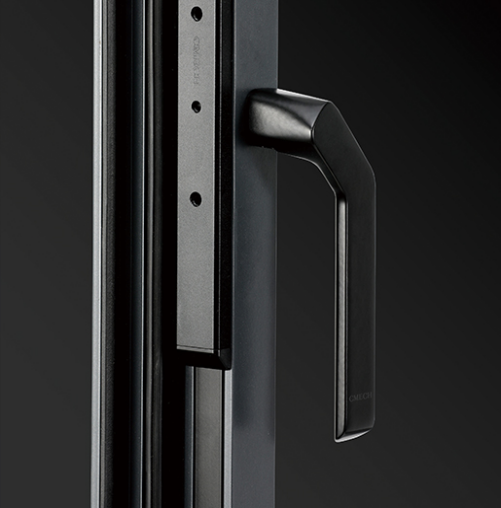
Handle Force Must Follow the Intended Load Path
Turning the handle creates torque at the handle, which passes through the spindle into the drive gear and locking points. The gear converts that input into distributed movement along the sash edge. If the spindle flexes or the gear sits off-axis, input becomes friction, leaving less force available to compress seals and complete locking.
The hinge carries a second part of the problem. Gravity loads the sash while the handle and drive move the locking line. A hinge that allows droop changes the relationship between keeps and locks, increasing handle effort. A stiff support structure keeps the sash on its reference plane, so handle torque produces lock travel rather than correction of a sagging panel.
We assess this force chain as window hardware, not a handle purchase. For commercial facades, the important consequence is repeatable closure after thermal movement, weather exposure, and maintenance access. Heavy-duty casement fittings require profile, reinforcement, hinge, drive, and window handle selection together, because a strong handle cannot compensate for a distorted sash or poor anchorage.
Which Specifications Define a Commercial Casement System?
We begin with operating range: sash width, height, mass, profile depth, and expected wind pressure. Next, we confirm spindle diameter, gear material, hinge capacity, sealing layout, and drainage. These variables help determine whether the handle and drive mechanism are compatible with the intended sash configuration and operating requirements.
สำหรับ casement window hardware kit, the published outswing system accepts sash widths of 400–750 mm, heights of 450–1,800 mm, and loads up to 50 kg. The system uses a 10 mm spindle, which is designed to provide greater torsional rigidity than a conventional 7 mm spindle. Those numbers define a practical sourcing boundary for facade applications.
Consider a hotel podium facade using 650 mm by 1,600 mm outward-opening units near the 50 kg limit. If procurement pairs a robust handle and drive with low-capacity hinges, the sash may droop and raise operating torque. Our engineering verdict favors a matched casement window hardware kit for commercial assemblies near their limits; local parts fit smaller, sheltered windows with lower load and sealing demand.
Seal Compression Turns Handle Torque Into Weather Control
Closing force has a purpose beyond keeping the sash shut. The handle and drive pull the sash against its gaskets, establishing compression that blocks air and water paths. Too little compression leaves gaps; too much increases operating torque and accelerates seal wear. The mechanism must balance lock travel with gasket resistance across seasons.
The CMECH built-in system uses a real-fit profile arrangement and triple sealing. Its published ratings include 700Pa watertightness, Grade 8 air permeability, and 5000Pa wind-load resistance. These figures matter mechanically because a supported sash maintains gasket contact under pressure. When the sash shifts, sealing becomes inconsistent even if the handle reaches its closed position.
During installation checks, technicians can inspect gasket compression at several points around the sash and cycle the handle through opening and locking. Changes in operating effort may indicate gasket friction, drive misalignment, hinge movement, or other installation-related issues. This test links operator feel to measurable weather performance, giving facade teams a way to diagnose a developing problem before it becomes a leak complaint or warranty dispute.
CMECH System Coordinates Handle and Hinge Components
For a high-traffic hotel podium, CMECH offers an outswing casement window built-in system that groups handles, drive parts, lock parts, load-bearing parts, and accessories. The outswing casement built-in hardware configuration pairs a 10 mm spindle with a carbon-steel drive gear using nano-blue treatment, plus a milling-free built-in hinge for slim 70 mm frame applications and coordinated facade installation.
The hinge has a patented anti-sag structure, U-shaped bent reinforcement plate, six solid rivets, and a 50 kg load capacity. Its design is intended to prevent sash droop and installation-plate deformation. Fast exterior drainage removes water from the system, protecting the drive and hinge from moisture. Together, these components keep operating torque tied to intended lock movement during service.
For a hotel facade project, buyers should assess the system against the required sash dimensions, maximum load, weather performance, and expected operating frequency. Our engineering verdict selects coordinated outswing casement window hardware for commercial units near capacity or exposed to weather. A different compatible handle and drive may suit smaller protected openings, but offer less assurance when hinge alignment and sealing are project-critical.
Sourcing Must Respect the Complete Facade Design
At CMECH, we view casement window hardware kit selection as a load-and-sealing decision, not a catalog shortcut. The limitation is important: hardware cannot correct under-designed profiles, excessive glass weight, weak anchors, poor drainage detailing, or installation beyond the published range. Facade calculations and profile checks should be completed before final hardware selection and project approval.
We recommend recording sash mass, handle operating effort, hinge setting, gasket compression, and drainage checks with each facade package. When a window handle, drive gear, and built-in hinge are sourced as one system, commercial operation becomes easier to maintain and troubleshoot across the building lifecycle and service program.
 English
 Arabic
 Chinese
 French
 Thai
 Vietnamese