


A window can look perfect on a drawing and still get in the way every morning. Its open sash might project over a narrow balcony, or its handle might be awkward to reach across a kitchen worktop. Those small details are worth settling before the frame is ordered.
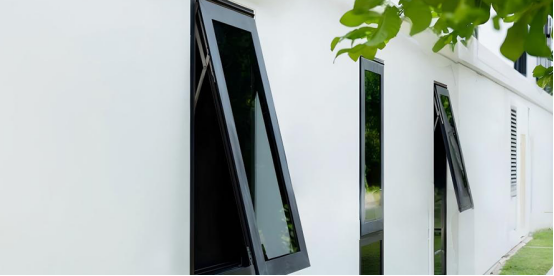
When comparing awning vs sliding windows, start with how the space is used. An awning window is hinged at the top and opens outwards at the bottom; a sliding window moves sideways within its frame. Choose an awning where outward clearance and controlled opening suit the room. Choose a slider where keeping the area outside clear matters. Then compare the actual ventilation opening, window sealing and operating effort of the proposed designs.
This guide follows that decision from room layout to hardware selection, showing where CMECH’s 遮阳篷窗五金 and 滑动窗口硬件 fit.
快速选择指南
- Choose a sliding design beside a frequently used walkway or a balcony with limited clearance.
- Consider an awning for a top-hinged opening where its outward movement will not obstruct people or fittings.
- Compare tested air leakage when window sealing is a priority, rather than relying on the opening style alone.
- Check the handle position and try the proposed mechanism before committing to large or heavy opening panels.
Make the Most of Your Space
Sliding windows are usually the more practical choice where space outside the opening is limited. Their panels move sideways within the frame, so they do not project over a narrow balcony, walkway or outdoor seating area.
For a small room, however, both designs can work because neither opens into the interior. An awning window is hinged at the top, with its bottom edge opening outwards. It needs enough clearance outside, while a sliding window needs room within its track for the moving panel.
When comparing awning vs sliding windows, look at the space on both sides of the opening. Picture opening the window above a kitchen worktop or beside an outdoor dining table: can you reach the handle comfortably, and will the open sash get in anyone’s way?
For a replacement project, draw the proposed opening on the existing elevation. Changing the operating type can change frame divisions, fixing details and usable opening dimensions. It is usually a complete-window decision, not simply a hinge or handle swap.
Awning vs sliding windows at a glance
| Decision | Awning window | Horizontal sliding window |
| Opening movement | Bottom edge projects outwards | Sash travels sideways within the frame |
| Space outside | Needs clear space for the open sash | No outward sash swing |
| Ventilation opening | Depends on sash size and permitted opening angle | Depends on panel arrangement and available travel |
| Hardware to examine | Hinges, stays, handle and locking mechanism | Rollers, track, handle and locking mechanism |
| Seal comparison | Hinged closure can press the sash against seals | Conventional and specialised sealed sliding designs differ |
| Everyday trial | Can the user reach, open and close it comfortably? | Can the user move the panel and engage the lock comfortably? |
Use this comparison to narrow the choice. The next step is to look at the actual opening, because two windows with similar overall dimensions can behave quite differently.
Which design gives you useful ventilation
Neither design provides more ventilation in every room. The useful opening depends on its clear area, opening limits, screens and the route air can take through the space.
In a typical two-panel slider with one fixed panel, the moving panel overlaps the fixed one. The clear opening is therefore smaller than the whole window. Other track and panel arrangements change that relationship. With an awning, the opening angle and any limiting device determine how far the sash can move.
This is where 遮阳篷窗五金 needs to be considered early: a stay chosen to control movement also influences the opening available for air. Similarly, 滑动窗口硬件 must allow the intended travel without clashes at handles, stops or adjacent panels.
CMECH’s 户外推拉窗及遮阳篷窗的安装解决方案 offers 6-, 8- and 9-inch restricting stays to suit different sash widths. The restricting stay helps control the sash in its top-hinged awning position, making its selection relevant to the available opening and ventilation strategy. When specifying the hardware, the stay should therefore be considered alongside the sash dimensions and required opening range rather than treated as an isolated accessory.
A Closer Look at Sealing and Airtightness
Generally, awning windows tend to leak less air than conventional sliding windows when closed. Their closing action presses the sash against the seals, while conventional sliders rely on seals that accommodate sideways movement.
However, sliding systems vary. CMECH’s Tightly Sealed Sliding Window System includes continuous full-perimeter gaskets, so its window sealing arrangement should be assessed separately from that of a conventional slider.
To choose between specific products, compare complete-window air-leakage test results under equivalent conditions. Effective window sealing depends on the seals, hardware alignment, frame construction and installation working together. The opening style provides a useful starting point, but the tested assembly determines the actual performance.
Choose hardware around the sash you actually intend to build
Once the opening style is clear, the hardware needs to support its size, weight and movement. A heavier glazed panel changes the selection even when the frame looks similar.
CMECH’s Outswing Awning Window Hardware Solution combines friction hinges, a limiting stay and multipoint locking. Its 304 stainless-steel friction hinge is available in C- and K-groove versions for different profiles, with a 3.5 mm support arm and multiple 8 mm solid rivets. The hinge has been tested through more than 35,000 opening-and-closing cycles.
These details help identify the configuration to discuss with the fabricator. The cycle figure shows how many opening-and-closing cycles the hinge underwent during testing, rather than setting a limit on its service life.
CMECH’s Sliding Window Hardware Solution includes rubber-coated rollers with load options from 120 kg to 300 kg. Its S Metro Handle offers automatic or manual locking. These components address different needs: rollers support panel movement, while the handle provides the locking action.
Keep the full sash weight, dimensions and profile together when asking for a selection. A maximum capacity is not permission to combine every largest dimension with every hardware option.
Try the window as its occupants will use it
A showroom sample is most useful when you test more than its appearance. Open it from the position someone will stand in, close it fully and operate the lock. For a kitchen, imagine reaching across the worktop. For a balcony, check movement from both sides of the opening.
Ask how the exterior glass can be cleaned safely and how the moving parts can be serviced. Include access to 遮阳篷窗五金 or 滑动窗口硬件 in the maintenance plan, particularly where fixed screens or surrounding finishes may restrict access.
可靠 window sealing also needs routine attention. A change in closing effort or an uneven gap is worth investigating before forcing the handle. Record the approved configuration so future replacement parts can be matched accurately.
常见问题
Is there one winner in awning vs sliding windows
No. The right choice depends on the available space, ventilation needs and ease of use and maintenance. Sliding windows are useful beside narrow balconies or outdoor walkways because they open sideways within the frame. Awning windows are an option where there is enough space outside for the sash to open outwards.
Does a larger window always give more airflow
No. Overall glass area and clear opening area are different. Ask for the actual opening dimensions with the proposed stops, screens and operating limits in place.
What should a supplier quote include
Request the full window configuration, glazing, hardware models, installation scope and relevant performance evidence. Compare equivalent proposals rather than assuming an opening style has a fixed price advantage.
Find the right opening for your project with CMECH
The best result is a window that fits the room when open and closes comfortably when it is time to shut out the weather. If you are weighing awning vs sliding windows, 联系CMECH with the opening dimensions, profile and glazing weight. Ask its team to review the appropriate 遮阳篷窗五金 or 滑动窗口硬件, together with the window sealing requirements, before finalising the design.
 English
 Arabic
 Chinese
 French
 Thai
 Vietnamese