
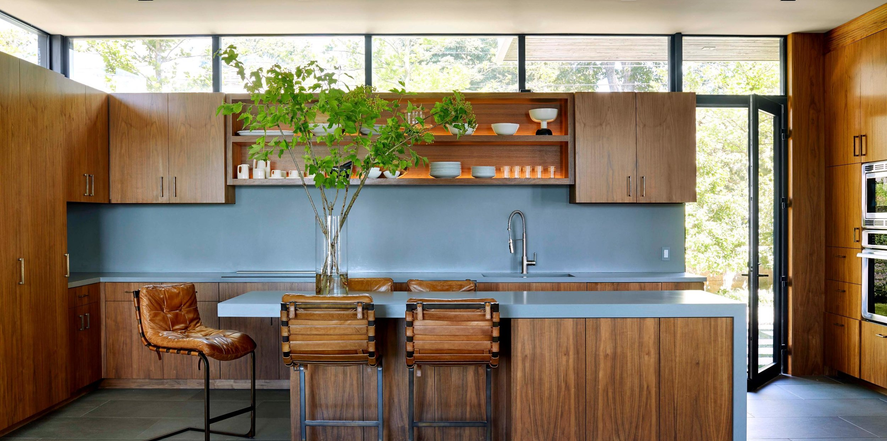


A swinging door can look minimal while carrying substantial forces through hinges, pivots, locks, and the frame. When those parts sit too deep or adjust poorly, the leaf sags, seals unevenly, and demands extra closing effort. Low-profile mechanisms address this geometry by shortening the force path without sacrificing alignment or practical installation tolerances.
A slim swing door still needs room for its hinge, locking mechanism, and adjustment. CMECH coordinates these components with handle action and the frame so architects can evaluate a restrained sightline alongside panel support, sealing, and service access.
Hinge Geometry Shapes the Architectural Door Hardware System
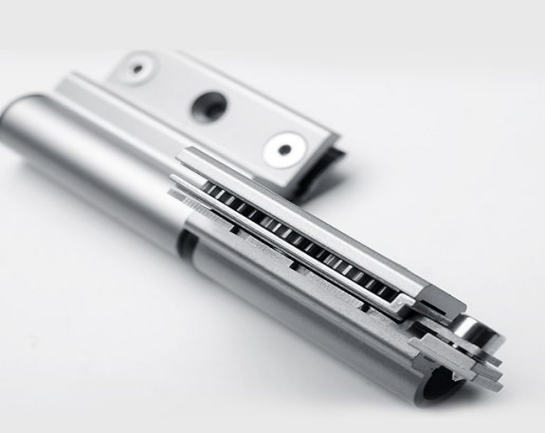
A swinging door acts as a lever: its weight creates a moment at the hinge side because the leaf’s center of gravity lies away from the hinge axis. The hinge must transfer that load into the frame while fitting the available profile and preserving the architectural sightline. Leaf width, glazing mass, hinge position, and frame strength therefore guide the hardware selection.
The CMECH hinged-door range includes three-axis adjustable hinges rated at 120, 140, or 180 kg. These capacities give fabricators a starting point for matching the hinge to the door schedule, but they do not replace checks of leaf dimensions, glazing weight, lock-body position, fixings, and frame stiffness. A coordinated hardware set is appropriate only when those interfaces are confirmed together.
When the hinge axis remains stable, the leaf rotates without dragging, the lock reaches its strike position, and the gasket compresses along a predictable line. Vertical, lateral, and depth adjustment help installers correct the assembled clearances before handover. The practical result is controlled closing and repeatable sealing, while the frame and fixings remain responsible for carrying the actual door load.
Which Mechanisms Keep Slim Swinging Doors Aligned?
The useful comparison is between a coordinated low-profile system and shallow parts selected independently. A coordinated system establishes hinge centers, lock backsets, shootbolt positions, and handle geometry together. Fragmented selection may look slim on paper, yet small offsets consume adjustment range and make the leaf twist as it approaches the strike during closing, especially under repeated traffic and changing weather.
For 平移门五金, we review panel width, height, weight, hinge capacity, and lock-body centerline together. The hinged-door range lists sash widths from 500 to 1,200 mm, heights from 1,920 to 3,000 mm, and hinge capacities of 120, 140, or 180 kg. Those limits define a system boundary, not a shortcut for project approval or field substitution.
Consider a 1,000 mm wide glazed entrance leaf weighing 140 kg in a boutique hotel. If hinge capacity is adequate but the lock centerline or frame anchor is misplaced, the leaf can still rub and miss compression. Coordinated swinging doors hardware suits heavy, frequently used entrances; lighter combinations fit smaller leaves with modest cycles and forgiving tolerances in protected interiors with stable conditions.
Adjustment Converts Hidden Geometry Into Service Control
We treat adjustment as a planned operating feature. Installers first set hinge height and lateral position, then confirm leaf plane, strike engagement, gasket compression, and shootbolt travel. Each correction should address one direction at a time. Changing several screws together can hide the original error and leave maintenance teams without a repeatable service reference.
Three-axis hinge adjustment is especially useful because building tolerances rarely disappear after fabrication. Vertical tuning recovers a small sag; lateral tuning restores the reveal; depth tuning balances seal compression against handle effort. The physical cause is simple: moving the hinge center changes the lever geometry. The consequence is measurable, with smoother rotation, cleaner lock engagement, and less edge impact at the jamb and strike.
Our commissioning record includes opening force, closed gaps, latch position, and compression at the top, middle, and bottom of the leaf. We also cycle the door through partially open positions, where gravity and wind can load the hinge differently. A low-profile mechanism earns its value when these measurements remain stable after repeated use instead of requiring improvised packing or repeated callouts.
CMECH Hinged Door Hardware Integrates Slim Components
For a boutique hotel entrance renovation, CMECH provides a hinged-door solution combining handles, drive parts, lock parts, load-bearing parts, and accessories in one package. The system includes three-axis adjustable hinges in 120, 140, and 180 kg capacities, a cam-roller handle with four-spring auto-return, a stainless-steel faceplate, and a high-strength zinc-alloy lock housing. This combination provides hardware options for projects that require different hinge capacities and coordinated locking components.
Its swinging doors hardware uses a high-wear-resistant plastic slider to reduce wobble, while the bi-directional shootbolt connector uses a groove-penetration design and positioning steel ball to limit play. The handle is tested to 120,000 cycles, and the system lists 28 or 33 mm lock-body centerlines. These details support alignment within a slim frame and repeatable closing during busy daily operation.
For the hotel, this configuration fits because a busy entrance needs controlled closing, acoustic and thermal sealing, and accessible adjustment after installation. Our engineering verdict favors the coordinated CMECH package when glazing is heavy or the frame is narrow. Simpler hinge sets suit lighter interior doors with lower cycle demand and forgiving alignment.
Low Profile Does Not Remove Structural Responsibility
For the boutique hotel entrance, select hinge capacity and lock geometry against the actual leaf weight and frame dimensions before approving the low-profile detail. Check that the installed door closes consistently and that the adjustment points remain accessible to the service team.
Keep hinge axes, lock centerlines, and initial settings in the handover record. A slim mechanism can support the desired appearance, but frame squareness, anchors, glazing, and correct installation remain essential to maintaining the door’s clearances.

 English
 Arabic
 Chinese
 French
 Thai
 Vietnamese