



Window hardware has a direct impact on how an awning window performs after installation. For architects, window manufacturers, developers, and project buyers, the comparison between European-style and traditional American hardware is therefore more than a matter of appearance. We need to consider how the hardware supports the sash, controls opening, distributes locking pressure, and contributes to weather sealing. Understanding these differences helps us select the right system for specific building requirements.
Different Approaches to Awning Window Hardware
Traditional American window designs often separate operating and locking functions. Andersen, for example, classifies casement and awning hardware into operator hardware and lock hardware, with the operator located at the bottom of the window and lock hardware positioned at the frame. This approach provides a familiar operating method and remains widely used in residential window systems.
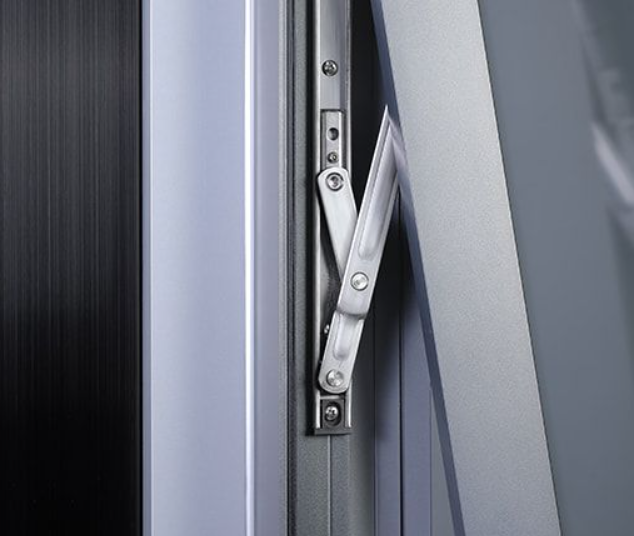
European-style 遮阳篷窗五金 typically places greater emphasis on coordinated mechanisms. Rather than evaluating the operator, hinges, stays, and locks as completely independent components, we can treat them as parts of one hardware system. This integrated approach can help manufacturers address sash stability, controlled opening, sealing, and security together.
The distinction should not be understood as a simple comparison between “European” and “American” quality. American manufacturers also offer advanced multi-point solutions. Truth Hardware, for example, provides concealed multi-point locking systems specifically for casement and awning windows, demonstrating that integrated hardware is also established in the American market.
Why Multi-Point Locking Matters
For commercial and residential projects, locking performance is an important consideration when specifying casement awning window hardware. A multi-point mechanism can engage the sash at several locations, helping distribute closing forces and maintain more consistent contact between the sash and frame.
Traditional configurations can also include multiple locks. Andersen notes that its awning windows use two lock mechanisms positioned on the left and right sides of the frame. The important consideration for project buyers is therefore not simply the number of locks, but how the components work together within the complete window assembly.
CMECH approaches this requirement through a coordinated multi-point locking structure in its outswing awning window hardware solution. The system is designed to improve water tightness, air tightness, and wind pressure resistance, while precision transmission components support smooth operation and long-term reliability.
Hinge and Stay Design Affect Stability
Locking performance is only one part of the system. The friction hinge must support the sash through repeated operation, while the limiting stay controls how far the window opens and helps manage movement under changing conditions.
CMECH specifies a 304 stainless steel friction hinge in both C-groove and K-groove versions. Its construction includes a reinforced 3.5 mm support arm, multiple 8 mm solid rivets, and a three-arm structure. The hinge has been tested to more than 35,000 open-and-close cycles, providing a useful durability reference for projects where repeated operation is expected.
The limiting stay is available in sizes from 8 to 20 inches. It automatically locks when opened and is designed to provide wind resistance and prevent sudden closure. Manufactured entirely from 304 stainless steel, it provides a robust solution for applications where controlled sash movement is important.
Matching Hardware to Window Specifications
For business buyers, compatibility should come before selecting a hardware style. We need to check sash dimensions, profile configuration, hardware grooves, expected sash weight, opening requirements, and the environmental conditions of the project.
的 CMECH outswing awning window hardware solution supports sash widths from 400 to 2,000 mm and sash heights from 400 to 2,000 mm, with a specified load-bearing capacity of up to 130 kg. The solution is available in standard and curtain wall configurations, giving manufacturers flexibility when developing different window systems.
These specifications are especially relevant during project planning. Selecting hardware according to actual sash dimensions and load requirements can reduce compatibility issues during fabrication and installation. It also allows window manufacturers to evaluate the complete system before committing to a particular hardware configuration.
Which Approach Is Better for Modern Projects?
There is no universal answer that makes one regional hardware philosophy suitable for every project. Traditional American hardware can offer familiar operator-based configurations, while European-style systems can provide an integrated approach to operating, locking, supporting, and controlling the sash.
For us, the better selection depends on the performance objectives of the window rather than its geographic label. When security, weather sealing, durability, profile compatibility, and controlled opening all matter, evaluating the complete hardware system gives project teams a more reliable basis for specification.
Making a Better Hardware Selection
A successful awning window project requires more than choosing an attractive handle or lock. We need to evaluate how each component contributes to the complete window’s performance. Multi-point locking, durable friction hinges, controlled opening, suitable load capacity, and profile compatibility should all be considered together.
With its integrated outswing solution, we at CMECH give window manufacturers, architects, and developers a system-oriented option for projects requiring dependable casement awning window hardware. By comparing complete mechanisms rather than individual components, we can make more informed decisions and create window systems that deliver reliable operation, stability, and weather performance over the long term.

 English
 Arabic
 Chinese
 French
 Thai
 Vietnamese