
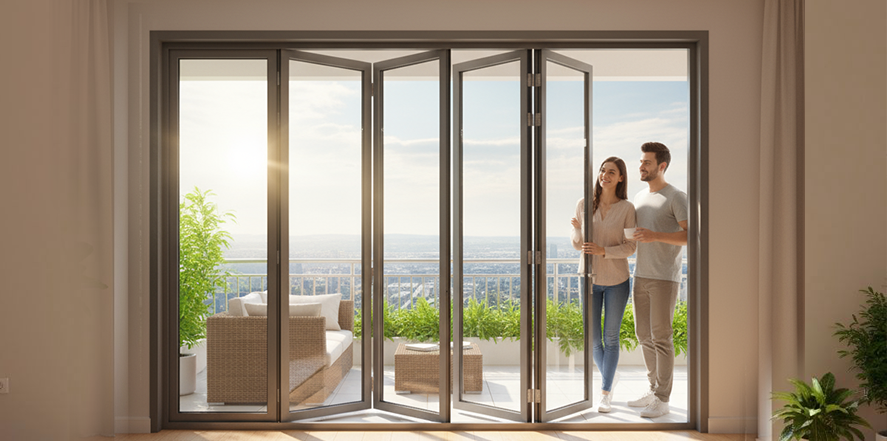


An open wall of glass makes a room feel generous and connected to the outdoors. When everyone leaves for the evening, the priority changes: every folding panel needs to close properly and stay securely in place. That raises a practical question for anyone choosing the hardware: what actually holds the whole opening together?
Bifold doors can provide effective security when the locks, bolts, hinges, glazing and frame form a properly specified, tested and installed assembly. For specifiers, the decision starts with how each panel is secured and the evidence supporting that arrangement.
This guide follows the closing sequence, explains the hardware involved and sets out what to request before placing an order.
A quick guide to a secure specification
- Choose a coordinated locking arrangement for the exact panel layout and everyday access needs.
- Choose bifold door hinges and rollers suited to the finished panel weight, dimensions and profile.
- Verify security evidence for the proposed doorset, including its hardware and glazing.
- Verify that users can follow the complete locking sequence and that service adjustments remain accessible.
Start with how the panels close
A folding opening contains several moving connections. Some layouts include a traffic door: a panel used for everyday entry without folding the whole assembly. Other layouts require a different sequence to open and secure the panels. Establish that sequence before choosing the handles and locks.
Ask the fabricator to mark the locking locations on the elevation drawing. Which panel closes first? Where do the remaining panels engage with the frame? Which controls must the occupant operate before the opening is fully locked?
This turns security into something the project team can review. It also helps avoid a familiar handover problem: a user locks the everyday access panel without understanding the separate steps needed to secure the folding stack.
Give the locks something solid to engage with
Multipoint bifold door locks engage at several locations along the closing edge. Each locking point works with a keep, the receiving component that holds the bolt or hook when the door is locked. Their positions, fixings and supporting profile all contribute to the assembled system.
When comparing bifold door locks, ask for the compatible keeps and fixing details as part of the same specification. Where a cylinder is used, its selection and protection also belong in that review. A longer list of locking points alone cannot establish how the completed opening will resist an attempted break-in.
The practical question is whether the proposed assembly has relevant security evidence. In England, Approved Document Q addresses security in new dwellings and emphasises robust construction, appropriate hardware and installation. Other markets have their own requirements.
Securing the folding panels
Shootbolts extend from a panel into receiving points in the surrounding frame, commonly at the head and threshold. They help restrain that panel when the opening is closed. Their contribution depends on proper engagement with the receivers and the construction supporting them.
For a fabricator, the useful checks are practical: can the bolts travel fully, are the receiving points correctly positioned, and can the user complete the locking action without forcing the handle? Include these checks in the installation instructions and handover demonstration.
The solution supports sash widths of 500–900 mm, heights of 1,900–3,500 mm and panel weights of up to 150 kg. Both upper and lower rollers feature a dual-guide wheel design for stable tracking. The lower roller provides vertical adjustment from −1.5 mm to +3 mm.
For odd-numbered panel layouts, CMECH’s Odd Configuration Bi-Folding Door Hardware applies the same system-based approach, with 120 kg or 150 kg load ratings depending on the configuration. In both cases, the locking and load-bearing components should be specified together so that the door layout, panel weight, alignment and closing performance are considered as one coordinated hardware system.
Why hinges belong in the security discussion
Bifold door hinges connect the panels and allow the assembly to fold. Their selection affects how the leaves remain positioned as they move and close. If the panels lose alignment, the locking components may no longer meet their receivers correctly.
Within CMECH’s Even Configuration Bi-Folding Door Hardware, the hinges work alongside the adjustable roller system to help maintain the position of the folding panels throughout operation. This matters to security because panel alignment affects whether locks and shootbolts meet their receivers correctly when the door closes. Rather than assessing the hinge as an isolated component, specifiers should consider how the hinge, roller and locking arrangement maintain the intended panel geometry across the complete folding system.
Ask for evidence that matches your opening
Security evidence should cover the doorset being proposed. A doorset is the complete assembly, including the frame, leaves, glazing and essential hardware. The evidence provided should therefore relate to the proposed construction, dimensions, panel configuration and hardware arrangement rather than to an individual component in isolation.
Ask the doorset supplier or fabricator for the applicable security test or certification documentation and check which sizes, configurations and hardware combinations are covered. The named hardware brand alone does not establish the security classification of the completed doorset.
Keep this review specific. If a tested configuration uses particular bifold door locks, changing the lock, keep, fixing arrangement, glazing or panel layout may affect whether the existing evidence remains applicable. Confirm permitted variations with the doorset or system supplier before approving substitutions.
For bifold doors, this connects the specified security performance with the complete assembly that will actually be fabricated and installed.
The checklist to use before ordering
Bring the drawings, hardware schedule and evidence together in one review. Each item below should have a clear answer or supporting document.
| Specification item | What to request |
| Panel layout | Opening direction, traffic-door arrangement and closing sequence |
| Bifold door locks | Model, keeps, cylinder where applicable, and approved fixing details |
| Shootbolts | Locations, compatible receivers and full-engagement checks |
| Hinges and rollers | Matched components, sash weight, size limits and adjustment access |
| Glazing and frame | Glass configuration, retention details and structural fixing instructions |
| Security evidence | Applicable standard, result and scope covering the proposed assembly |
| Handover and servicing | Operating instructions, inspection requirements and replacement-part information |
Use the checklist to resolve decisions before fabrication. For example, a change to the threshold may require another look at the bottom bolt receiver, while a heavier glass specification needs review against the approved support arrangement. Keeping those changes together helps the team avoid approving one component in isolation.
Make secure operation part of the handover
The handover should demonstrate the complete closing sequence with the installed doors. Ask the installer to show how each panel seats, how each locking control operates and how the occupant can check that the opening is secured.
Keep the operating instructions and hardware schedule available for future servicing. Report any change that makes locking difficult, such as rubbing panels, loose components or a handle that needs increasing force. Adjustment should follow the system instructions so that restoring smooth movement also preserves correct engagement.
Frequently asked questions
Are bifold doors secure enough for a ground-floor opening?
They can be, provided the complete assembly has suitable security evidence for the project and is installed correctly. Ground-floor access should inform the required security specification, alongside local requirements and any insurer conditions.
Do shootbolts replace a multipoint lock?
Their roles depend on the layout. They commonly secure folding panels while a multipoint lock secures a closing edge. Review the complete locking arrangement to establish which functions the opening needs.
What should I check when choosing bifold door locks and hinges?
For bifold door hinges, start with the exact profile, panel dimensions, finished weight and opening arrangement. Review their compatibility with the locking system, fixing details, adjustment access and the security evidence covering that combination.
Can a different replacement lock be fitted later?
Ask the system supplier to approve the replacement. Matching visible dimensions does not establish compatible operation or preserve the scope of the original security evidence.
Plan your folding-door hardware with CMECH
Secure bifold doors should be straightforward to close and lock every day. Contact CMECH with the panel layout, profile drawings, sash dimensions and weights, and your project’s security requirements. Ask about compatible locks, shootbolts and hinges, and the configuration information your fabricator needs to develop the complete doorset.


 English
 Arabic
 Chinese
 French
 Thai
 Vietnamese