


Energy-efficient windows reduce unwanted heat transfer, solar heat gain, and air infiltration. They help buildings use less energy for heating and cooling while improving indoor comfort. An efficient window is not defined by glass alone. Glazing, frame, seals, hardware, and installation must perform as one system.
Key Indicators of Window Energy Efficiency
U-factor
The U-factor measures how quickly heat passes through the complete window assembly. A lower U-factor means better insulation and less heat loss.
Solar Heat Gain Coefficient
The Solar Heat Gain Coefficient, or SHGC, measures the fraction of solar energy that enters through the window.
A lower SHGC can reduce unwanted heat gain in hot climates, especially on east, south, and west-facing façades. In colder climates, a higher SHGC may help capture useful solar heat during winter.
Air leakage and visible transmittance
Air leakage measures the amount of air that passes through joints in the window under a defined pressure difference. Lower air leakage generally means fewer drafts, less uncontrolled heat transfer, and improved indoor comfort.
Visible transmittance, or VT, measures the amount of visible light that passes through the glazing. A higher VT can increase daylight, but it should be balanced with glare control and solar heat management.
When assessing energy-saving windows, review these ratings together:
– A low U-factor limits heat transfer.
– A suitable SHGC controls solar heat gain.
– Low air leakage reduces drafts and energy loss.
– Appropriate VT supports daylight without creating excessive glare.
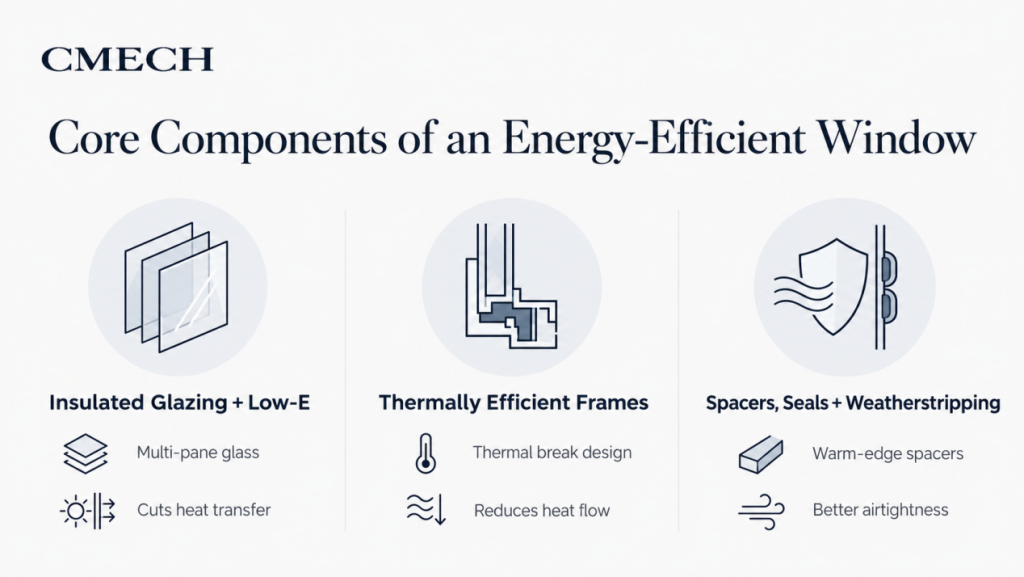
Core Components of an Energy-Efficient Window
Insulated glazing and Low-E coatings
Insulated glazing uses two or more panes separated by a sealed cavity. The cavity may contain air or an insulating gas such as argon. Compared with single glazing, insulated glazing reduces conductive heat transfer and helps keep interior glass surfaces closer to room temperature.
Low-emissivity coatings, commonly called Low-E coatings, are thin layers applied to glass surfaces. They reduce radiant heat transfer while allowing manufacturers to control solar gain and daylight. A Low-E coating can be selected for higher solar gain in colder regions or lower solar gain where cooling demand is dominant.
Thermally efficient frames
The frame also affects the window’s thermal performance. Aluminium frames should include thermal breaks to reduce conductive heat flow between the exterior and interior. Timber, vinyl, and fiberglass frames generally conduct less heat, but their performance still depends on design, reinforcement, drainage, and manufacturing quality.
Spacers, seals, and weatherstripping
Spacers separate the panes and help maintain the insulating cavity. Warm-edge spacers can reduce heat transfer at the glass perimeter and may lower the risk of condensation.
Seals and weatherstripping close the gaps between the frame and sash. Their material, compression, continuity, and resistance to ageing all influence long-term airtightness. A high-performance glazing unit cannot compensate for damaged or poorly fitted seals.
How Window Hardware Affects Energy Performance
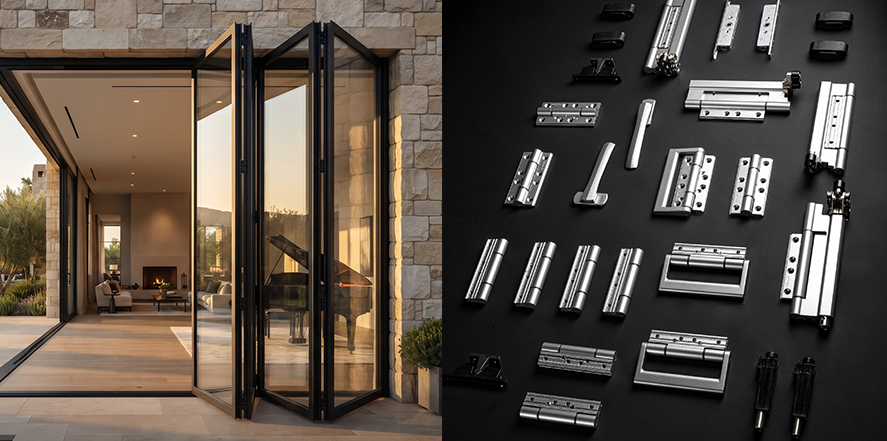
Window hardware controls how the sash closes against the frame. Multi-point locking distributes closing pressure at several locations, which can compress the seals more evenly than a single lock. Consistent sealing pressure reduces gaps that may allow air and water to enter.
Hinges and sash alignment are equally important. If a sash drops, twists, or becomes difficult to close, the weather seals may no longer meet evenly. The result can be higher air leakage, noise, moisture entry, and premature seal wear.
Long-term airtightness depends on more than the initial fit. Hardware must continue to operate correctly after repeated opening and closing, temperature changes, and exposure to moisture. Compatible drives, hinges, handles, locking points, and profiles reduce the risk of uneven loading or incomplete closure.
Which Window Styles Are Most Energy Efficient?
Window style affects how effectively the sash closes against the frame and compresses the seals. In general, fixed, casement, awning, and tilt and turn windows offer stronger airtightness than conventional sliding windows.
Fixed Windows
Fixed windows usually provide the best airtightness because they have no moving sash. They are a strong choice for living rooms, staircases, and other areas where ventilation is not required.
Casement and Awning Windows
Casement windows are hinged at the side, while awning windows are hinged at the top. When closed, the sash presses firmly against the frame seals, helping reduce air leakage.
These styles are among the most practical choices for energy-efficient windows because they combine good ventilation with reliable sealing. They work particularly well with insulated glazing, Low-E glass, and thermally broken frames.
Tilt and Turn Windows
Tilt and turn windows offer two opening positions. They can tilt inward for controlled ventilation or turn inward for a larger opening. When fully closed, their multi-point locking system applies pressure around the sash perimeter.
This makes tilt and turn windows a strong option for projects that need both ventilation and airtightness. Correct installation and adjustment remain important, especially for larger sashes.
Sliding Windows
Sliding windows save space and provide convenient operation, but traditional sliding designs are usually more difficult to seal. Because the sash moves along a track, it does not compress the frame seals in the same way as a casement window.
A sliding window can still perform well when it uses continuous gaskets, accurate sash adjustment, and a properly designed locking system. Without these features, air leakage and water penetration may become long-term concerns.
CMECH Solutions for Energy-Efficient Window Styles
CMECH’s integrated window hardware systems are particularly relevant to casement, awning, tilt and turn, and tightly sealed sliding windows.
Its outswing casement window system uses triple sealing between the frame and sash and lists an air permeability rating of Grade 8 under its stated test conditions.
Its tilt and turn system includes adjustable sealing geometry, helping installers fine-tune sash position and sealing pressure.
For sliding windows, CMECH’s tightly sealed sliding window system uses multi-channel, continuous full-perimeter gaskets to create a more complete barrier against air and water entry.
For projects where energy performance is a priority, casement, awning, and tilt and turn windows are usually the safer recommendation. If a sliding design is required, a system engineered specifically for tight sealing, such as CMECH’s solution, is a more dependable choice than a conventional sliding arrangement.
How to Choose the Right Energy-Efficient Window
Match the window to the climate
In cold regions, prioritize a low U-factor, low air leakage, and suitable solar gain. In hot climates, a low SHGC can reduce cooling loads, while a low U-factor limits heat transfer through the building envelope.
Compare whole-window ratings
Do not compare the glass specification of one product with the complete-window rating of another. Review:
– U-factor
– SHGC
– Air leakage
– VT
– Condensation resistance
– Wind and water performance, where available
Check compatibility
The hardware should match the frame profile, glazing thickness, sash dimensions, and operating weight. A suitable hardware system must also align with the window manufacturer’s production method and adjustment requirements.
Consider installation and maintenance
The opening must be square, the frame must be correctly supported, and the perimeter joint must be sealed with compatible materials. After installation, inspect locking pressure, sash alignment, drainage paths, and weatherstripping.
Regular cleaning, lubrication, and adjustment can help preserve performance. A well-designed window can lose efficiency if maintenance is ignored.
结论
Energy-efficient windows depend on more than glass and frames. The right hardware is essential for reliable operation and long-term sealing performance.
Looking for reliable window hardware solutions for your next project? CMECH provides integrated hardware systems for casement, awning, tilt and turn, and sliding windows. Contact CMECH to discuss your project requirements and explore tailored hardware solutions.
 English
 Arabic
 Chinese
 French
 Thai
 Vietnamese