
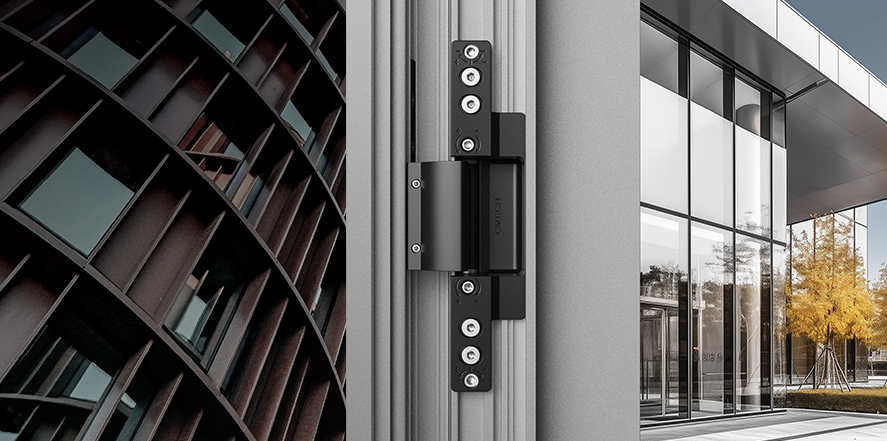


Load, adjustment and anti-sag performance
When a heavy aluminium door begins to sag, scrape the threshold or resist closing, the hinge is often blamed but the real problem may have started during selection. Choosing heavy duty hinges for aluminium doors means looking beyond a single weight rating and matching the hardware to the finished leaf, profile, fixing method and operating demands. The right door hinges for aluminium doors should carry the load, allow accurate adjustment and help the door remain aligned through repeated use.
Quick decision guide
- Choose heavy duty hinges for aluminium doors after confirming leaf weight, size and use frequency.
- Choose adjustable door hinges for aluminium doors for post-installation alignment.
- Choose door hinges for aluminium frame profiles only with compatible fixings and reinforcement.
- Choose the frame hinge arrangement stated by the supplier; never divide weight equally without evidence.
- Choose narrow hinges only when their capacity and fixing engagement suit the profile.
- Do not substitute screen door hinges for rated heavy-door hardware.
- Verify the exact CMECH system, profile, door size, hinge quantity and installation conditions.
How do I choose the right heavy-duty hinges for an aluminium door?
Start with the load, but do not stop there. Reliable hinges for aluminium doors must carry both the static weight of the closed leaf and the changing forces created as a tall or wide door opens, stops and closes repeatedly.
| Selection factor | What to verify | Why it matters |
| Finished leaf mass | Profiles, infill, locks, handles and accessories | The hinge supports the completed door |
| Door geometry | Width, height, thickness and centre of gravity | Width increases leverage at the hinge line |
| Use | Direction, angle, frequency and closer action | Opening creates dynamic loads |
| Connection | Fixing zones, fasteners and reinforcement | The profile connection can limit capacity |
| Adjustment | Height, lateral and compression settings | Supports alignment, gaps and sealing |
| Environment | Moisture, salt and cleaning chemicals | Exposure affects material and finish selection |
| Evidence | Drawings, limits and instructions | Ratings may apply to one configuration only |
Never assume three hinges carry three equal shares of the load. Spacing, door stiffness and fixing position affect distribution. Ask the supplier to confirm the leaf size and weight for the stated arrangement of heavy duty hinges for aluminium doors.
Why adjustment matters after installation
Three-axis adjustment normally means that an installer can make controlled corrections in three directions: vertical adjustment raises or lowers the leaf, lateral adjustment moves it towards or away from the hinge side, and compression adjustment changes how the door meets the frame and gaskets.
This makes adjustable hinges for aluminium doors useful after glazing or installation. Adjustment does not increase the load rating, repair weak fixings or compensate for a distorted profile; remain within the manufacturer’s stated range.
For a frame hinge, adjustment works only when the body, fasteners, reinforcement and profile form a compatible load path. Recheck clearances, lock engagement and gasket compression afterwards.
What does anti-sag performance mean?
Door sag is the gradual dropping or rotation of the leaf away from its intended position. Warning signs include an uneven head gap, contact at the threshold, resistance at the lock side or seals that no longer compress consistently.
An anti-sag design aims to control movement in the hinge and connection. It cannot overcome insufficient capacity, loose fasteners, weak reinforcement or poor installation. For heavy duty hinges for aluminium doors, ask what the feature controls, which load and size conditions apply, and what inspection is required.
Which hinge type suits a heavy aluminium door?
| Hinge type | Where it can work well | What to check |
| Adjustable side hinge | Entrance and commercial doors | Leaf limits, adjustment, fixings and corrosion protection |
| Concealed hinge | Clean sightlines | Cavity, access, opening angle and capacity |
| Continuous hinge | Long fixing line | Preparation, alignment, service and load scope |
| Slim-profile hinge | Restricted mounting width | Whether narrow hinges retain adequate fixing and capacity |
| Screen-door hinge | Light screen assemblies | Never substitute screen door hinges without load evidence |
No type is universally best. Select door hinges for aluminium doors by the application. Concealed hinges offer clean lines, continuous hinges use a longer fixing line, and adjustable side hinges simplify alignment; each requires configuration-specific evidence.
How profile width and fixing affect hinge selection
The phrase door hinges for aluminium frame does not mean one hinge fits every extrusion. Groove geometry, wall thickness, reinforcement and fastener access vary. Request a section drawing of the complete connection.
A frame hinge must transfer load into a stable fixing zone without deforming the profile. Reinforcement may be required. Narrow hinges are suitable only if reduced width preserves fixing, adjustment and capacity.
“Aluminium hinge” may describe material, appearance or intended door type. It does not prove suitability for an entrance door. Confirm material, surface treatment, fasteners and profile compatibility.
Where can I source heavy-duty hinges for aluminium doors?
Buy from a manufacturer or authorised supplier that provides model-level drawings, load and size limits, adjustment instructions and corrosion information. A low unit price becomes expensive if machining is wrong or remedial work follows.
When comparing hinges for aluminium doors online, request a quotation for the complete configuration. Provide leaf weight, dimensions, direction, profile drawing and exposure. For door hinges for aluminium frame, include fixing and reinforcement details. Treat generic screen door hinges and unverified narrow hinges as different categories unless documentation proves otherwise.
The best-value offer is the one that meets the verified requirement with predictable fabrication, installation and service—not necessarily the cheapest listing.
CMECH hinged-door hinge options
CMECH’s Hinged Door Hardware Solution includes hinge options with published capacities of 120 kg, 140 kg and 180 kg, together with full three-axis adjustment, anti-sag features and corrosion-resistant surface treatment. The overall solution covers door leaves measuring approximately 500–1,200 mm wide and 1,920–3,000 mm high.
Within this range, CMECH offers different hinge constructions for different aluminium-door requirements. Its 120 kg frame-and-sash flush hinge uses an aluminium-alloy construction with adjustment concentrated at the frame-side hinge. Internal gearing supports lateral adjustment, while a safety-screw fixing into the aluminium frame is designed to help resist door-leaf sagging.
CMECH also offers a 120 kg clamping hinge with a 304 stainless-steel bearing and a high-strength wear-resistant shaft sleeve. The hinge provides adjustment at the hinge shaft, while lateral clearance can be adjusted through the clamping connection. A long fixing screw passes through the aluminium profile to help secure the hinge and control downward movement of the door leaf.
These examples show why selecting heavy duty hinges for aluminium doors should involve more than comparing load ratings. Hinge construction, fixing method, adjustment range, profile compatibility and anti-sag design should all be considered alongside the door’s finished weight and dimensions.
Final selection checklist
Before approving a hinge schedule, confirm:
- The measured or calculated finished door-leaf mass
- Leaf width, height, thickness and centre of gravity
- Hinge type, quantity, spacing and opening direction
- Compatible profile, fixing pattern and reinforcement
- Adjustment axes and permitted adjustment range
- Anti-sag design and installation instructions
- Corrosion resistance for the actual environment
- Door closer, lock, seals and threshold interaction
- Test or published evidence for the complete configuration
- Maintenance access and replacement availability
Frequently asked questions
Can you recommend the best hinges for heavy doors?
There is no universal best hinge. A suitable heavy duty hinge for an aluminium door should be rated for the finished leaf mass and geometry, fit the profile and reinforcement, provide the required adjustment, and have appropriate corrosion and durability evidence.
Where can I find durable hinges for aluminium doors online?
Start with manufacturer product pages and authorised suppliers that publish technical documentation. When comparing door hinges for aluminium doors, check the stated load capacity, supported door size, adjustment range, environmental exposure and profile compatibility. Ask the supplier to confirm that the selected hinge is suitable for the complete door configuration before ordering.
For door hinges for aluminium frame profiles, the technical documentation should also show the fixing interface, compatible extrusion or reinforcement requirements.
Are door hinges made from aluminium always best for aluminium doors?
No. Hinges for aluminium doors may use different materials and surface treatments. Suitability depends on strength, wear, corrosion resistance, fasteners and compatibility with the aluminium profile—not whether the hinge and door share the same material name.
Can I use screen-door hardware on a heavy aluminium entrance door?
Usually not. Screen door hinges commonly serve lighter assemblies. Use them only when the exact model is rated for the completed entrance-door load and operating conditions; otherwise choose purpose-designed heavy-door hardware.
Do not compare screen door hinges with heavy entrance-door hardware as though the categories were interchangeable.
Do slim aluminium profiles require special hinges?
Often. Narrow hinges can fit restricted mounting areas, but the supplier must confirm capacity, screw engagement, reinforcement and adjustment. The correct frame hinge arrangement must match the actual extrusion rather than a generic frame description.
The approved frame hinge drawing should show its fixing location, reinforcement and adjustment clearances.
To assess a project, send CMECH the door-leaf dimensions, calculated weight, profile section, opening direction and environmental conditions. CMECH can then help identify a compatible hinged-door hardware configuration and the evidence that still needs verification.
 English
 Arabic
 Chinese
 French
 Thai
 Vietnamese