


A window that scrapes, drops or refuses to stay open often points back to one early decision: the hinge did not match the sash.
Choosing the right window hinge therefore takes more than matching its length or appearance. Opening direction comes first, followed by the completed sash size and weight, profile, fixings, movement and exposure. Well-matched casement window hinges and awning window hinges should guide the sash smoothly and keep the closing action predictable.
This guide turns those decisions into one practical window hinge selection process. It connects everyday operation with the measurements that fabricators, importers and specifiers need, then shows where CMECH’s configurations fit before hardware is ordered for a project with confidence.
Quick hinge selection guide
| Selection question | What to check | لماذا يهم الأمر |
| How does the sash open? | Side-hung, top-hung, inward or outward | Establishes the required movement geometry |
| What will the finished sash weigh? | Glass, frame, reinforcement and hardware | Determines the required load capacity |
| Which profile is being used? | Groove, stack height, mounting face and screw engagement | Controls physical compatibility and fixing strength |
| What movement is required? | Opening angle, restraint, adjustment and clearance | Supports safe, smooth operation |
| Where will it be installed? | Weather exposure, adjacent metals and maintenance access | Influences material and finish selection |
Use this information to shortlist options, not to assume interchangeability. Similar-looking window friction hinges can follow different travel paths and fixing patterns.
Are casement and awning window hinges interchangeable?
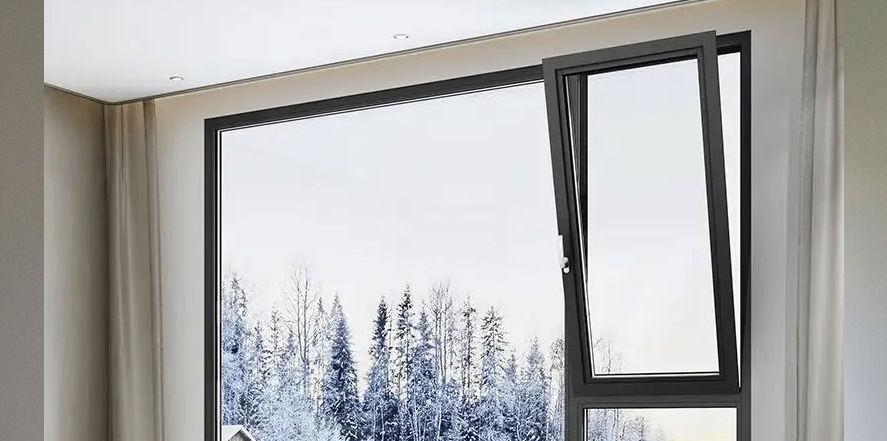
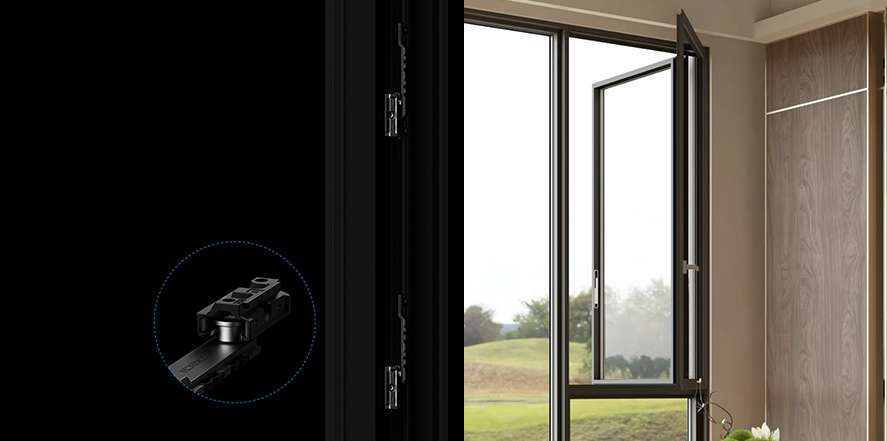
Generally, no. Casement window hinges support a side-hung sash, whereas awning window hinges control a top-hung sash that projects outward from the bottom. That change affects both gravity and wind loading.
Even within one product family, the handing, track, arm geometry, groove, fixing pattern and sash range must match. Two hinges of the same length can move differently or place load in different parts of the profile.
Review the surrounding hardware too. A casement system may combine hinges with a gearbox, restrictor and multipoint lock; an awning system may add a limiting stay for wind control. Changing one component can affect the whole opening.
How do I choose the right window hinge for casement and awning windows?
Start with the completed sash and work through these seven checks before comparing product codes.
1. Calculate the completed sash weight
Include the glass, frame, reinforcement and attached hardware. Thicker, laminated or acoustic glazing adds weight, while a wider sash places greater leverage on the hinge line.
Read every capacity with its stated dimensions and test scope. A hinge rating and a complete-configuration limit are not necessarily the same number.
2. Match the profile, groove and fixings
Compare the groove, track width, stack height, mounting position, screw locations, profile depth and reinforcement. For window friction hinges, a small change in fastener position can affect both engagement and travel. Drawings reveal details that photographs cannot.
لأجل casement window hinges, as for other types, the screws and reinforcement must suit the profile. A strong hinge cannot compensate for a weak fixing substrate.
3. Confirm opening angle and surrounding clearance
Check the required opening angle against walls, screens, façade features, walkways and cleaning access. A rated hinge is still unsuitable if the sash collides with the building or obstructs a route.
4. Decide whether movement needs restraint
Top-hung windows may need a limiting stay for wind control or occupant safety. Coordinate the hinge, stay, restrictor and lock, and check the required opening against ventilation, fall-protection and emergency-use obligations.
5. Use adjustment to refine alignment
Adjustment can even the gaps, correct sash position and manage gasket contact. It cannot correct overloading, weak fixings, bad machining or a distorted profile. Confirm the adjustment directions and post-installation access.
6. Match materials to exposure
The phrase stainless steel window hinges does not identify the grade, fasteners or corrosion-test scope. Review the hinge, screws, adjacent metals, drainage and maintenance plan together, especially where moisture, pollution or salt deposits are expected.
Cycle and corrosion tests answer different questions. Neither predicts service life in every building or climate.
7. Review the complete hardware arrangement
Finish with a system-level review. Locks, keeps, gaskets, drainage, profile stiffness, fabrication and installation all shape the completed window’s performance.
How CMECH configurations address different openings
CMECH organises its current hardware by opening type. Its stainless steel window hinges and related components should be read with the stated configuration range, not as one rating for every system.
| CMECH configuration | Current hinge information | Published configuration range |
| Outswing Casement Window Hardware Solution | C-groove or K-groove 304 stainless-steel friction hinge; 4 mm load-bearing arm; hinge capacity up to 60 kg (for C-groove) or 70 kg (for K-groove); tested through 30,000 opening-and-closing cycles | Width 300–750 mm; height 300–1,800 mm; complete window load up to 70 kg |
| Outswing Awning Window Hardware Solution | C- and K-groove 304 stainless-steel friction hinge; 3.5 mm support arm; multiple 8 mm solid rivets; tested through more than 35,000 opening-and-closing cycles; separate 8–20-inch limiting stay | Width and height 400–2,000 mm; configuration load up to 130 kg |
| Inswing Casement Window Hardware Solution | Stainless-steel hinges in 60, 80 and 100 kg specifications; thickened load-bearing arm; multidirectional fine adjustment | Width 300–1,600 mm; height 400–2,400 mm; configuration load up to 100 kg |
| Outswing Casement and Awning Window Hardware Solution | Double-baseplate upper and lower hinges; upper arm made from stainless steel up to 3.5 mm thick; anti-derailment hook; three-dimensional indoor adjustment | Width 425–800 mm; height 670–2,000 mm; configuration load up to 80 kg |
Load figures only make sense when tied to the configuration behind them. CMECH’s outswing casement solution shows why the hinge rating and the system limit should be read separately. An individual C-groove friction hinge is rated up to 60 kg and a K-groove hinge up to 70 kg, while the complete outswing casement window is rated up to 70 kg. Before specifying, check the hinge rating for your groove type as well as the complete-window limit.
The same principle applies to CMECH’s outswing awning solution, which supports loads of up to 130 kg within its specified system configuration. That figure is not a universal rating for all awning window hinges; suitability still depends on the complete hardware arrangement, profile and sash dimensions.
Capacity is only one part of hinge selection. The groove type must match the window profile, while capacity and cycle-test results relate to the specific hinge construction tested. Use the table to compare stainless steel window hinges, then confirm the product drawing, dimensions and sash configuration before specification.
How do I choose the correct replacement hinge for a casement window?
Identify the existing opening rather than relying on visual similarity. Record its direction, handing, hinge type, track length, arm arrangement, groove, stack height, fixing pattern, sash dimensions and completed weight, then compare the supplier’s current drawing.
Replace hinges as a set where specified. Mixing a new component with a worn or geometrically different partner can leave the sash uneven. Casement window hinges with bent arms, loose rivets, corrosion, uncontrolled movement or damaged fixings need assessment; scraping may also indicate a distorted sash, misaligned lock or loose keep.
Support the sash before disconnecting load-bearing hardware, and use a competent specialist for large, high-level or unfamiliar openings. A correct replacement should restore controlled travel, even clearances and easy closing.
Plan the hinge configuration with CMECH
The right window hinge should make a well-built sash feel predictable: it opens smoothly, remains controlled and returns squarely to the frame. Reaching that result means matching the hinge to the complete opening rather than relying on a photograph or capacity figure.
Planning a casement or awning project? اتصل بـ CMECH with the sash dimensions, completed weight, opening direction and profile drawing. CMECH can help identify the relevant configuration and provide product-specific information for review, whether the project requires casement window hinges, awning window hinges, window friction hinges or stainless steel window hinges.
Frequently asked questions
How much weight can a hinge support?
There is no universal capacity. It depends on the product, sash dimensions, geometry, profile and fixings. CMECH rates its outswing casement friction hinges up to 60 kg (C-groove) or 70 kg (K-groove) per hinge, within a complete-window limit of 70 kg. Its inswing casement hinges come in 60, 80 and 100 kg specifications. These figures belong to the named products, not unrelated window friction hinges.
What maintenance do friction hinges need?
Follow the product instructions. Keep accessible tracks and pivots clear of grit, inspect fasteners and arms, and use only approved lubricants. Window friction hinges that remain stiff, damaged or unable to control the sash need assessment, not more force.
Does stainless steel make a hinge maintenance-free?
No. Stainless steel window hinges resist corrosion, but deposits, unsuitable cleaners, incompatible fasteners and aggressive exposure can still affect them. Follow the product’s cleaning and inspection instructions.
What information should accompany a hinge enquiry?
Provide the opening type and direction, sash dimensions, completed weight, profile drawing, groove, glazing, required angle, exposure and destination market. For replacements, add measurements and clear images of the mechanism and fixings.
 English
 Arabic
 Chinese
 French
 Thai
 Vietnamese