



In a high rise, an inswing casement window changes the maintenance route. The sash opens toward the room, giving technicians direct access to hinges, locks, and seals. That geometry reduces exterior exposure while increasing the value of controlled load transfer, clearance planning, tenant coordination, access control, and repeatable adjustment during each service visit.
في CMECH, we engineer window hardware as a coordinated service system for residential towers. Our inswing casement windows combine hinge capacity, spindle drive, and multipoint locking so interior teams can inspect and adjust components without improvising. This configuration gives project teams a basis for planning interior hardware inspections and checking the components that contribute to window operation and sealing.
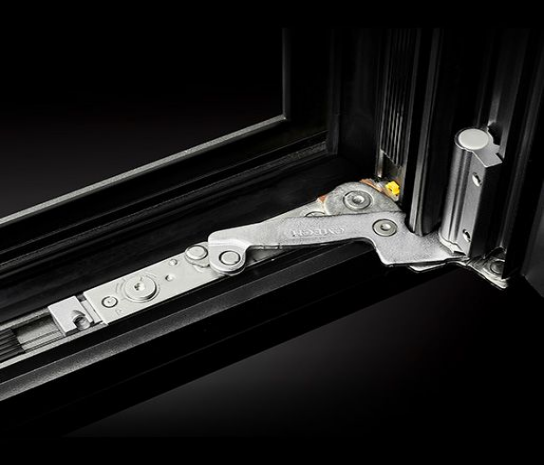
The Inward Opening Geometry Clarifies the Load Path
An inward-opening sash pivots around frame-side hinges, so gravity creates a moment that increases with glazing mass and projection. The hinges transfer that moment into the profile, while locking points stabilize the opposite edge. Because the opening occurs inside the room, technicians can observe the support path, check fasteners, and test movement without reaching through an exterior gap.
For a sash within the system’s 100 kg application limit, hinge-side misalignment can affect alignment and locking operation at the opposite edge. Corners drift, friction rises, and gasket compression becomes uneven. This physical chain shows why maintenance accessibility is an engineering outcome, not a convenience feature. Reachable components let technicians check torque, alignment, and fastener condition before local damage spreads through the operating system.
Inswing casement windows suit towers where façade access is expensive, weather-dependent, or restricted by occupancy rules. The inward-opening geometry keeps service work on the conditioned side, but it still requires a frame designed for reaction forces and interior clearance at design stage. Window hardware cannot compensate for weak anchorage, incorrect glazing weight, or a profile never matched to the sash.
How Does Multipoint Locking Keep Service Access Predictable?
Handle rotation enters a hexagon spindle drive gearbox and becomes linear movement directly along the sash. That motion pulls or releases several locking elements, distributing contact instead of concentrating force at one latch. Multiple contact points resist wind pressure and keep the sash seated, producing steadier gasket compression during repeated service across the perimeter.
On a tower specification, نافذة مفصلية ذات فتح للخارج hardware should be judged by drive travel, spindle center distance, and the installer’s ability to reach each adjustment. The product range lists T-drive lengths from 17 to 40 mm and spindle center distances from 11 to 35 mm. Those interfaces determine whether replacement parts fit without improvised drilling or damaging finished interior surfaces.
After a technician opens the sash, the same lock path provides a diagnostic map. A tight corner, loose corner, or stiff handle can indicate alignment, compression, or drive-related issues. Technicians should inspect the sash, locking points, and drive mechanism before identifying the cause. Recording these symptoms turns maintenance into a controlled sequence, reducing unnecessary part changes and protecting the frame from overload during service in high-rise rooms.
Adjustment Steps Make Tower Maintenance Predictable Inside Apartments
Adjustment begins with the sash closed and supported, because changing hinge position under load can shift the entire sealing pattern. We inspect diagonal alignment carefully, then use multi-directional hinge adjustment to center the sash before touching locking points in sequence. This order follows the load path from support to compression, preventing the lock from masking a hinge error.
For technicians, predictability comes from repeatable reference points rather than feel alone. We measure corner gaps, verify handle travel, and compare gasket contact around the full perimeter. If one adjustment changes two symptoms, the system is transferring force correctly; if each corner behaves independently, the frame or fasteners may need investigation before further tuning and retesting.
In high-rise apartments, inward opening lets a technician place tools, a flashlight, and a replacement component on the room side. That access reduces exposure time and makes scheduled inspections practical. It also helps teams coordinate window hardware with nearby door hardware, because circulation, furniture clearance, and emergency egress remain visible while work proceeds safely around occupied residences.
The Inswing Configuration Supports High Rise Maintenance
For a tower retrofit, the inswing casement windows solution from CMECH combines a hexagon spindle gearbox, multipoint locks, hinges, and load-bearing accessories. Spring-loaded positioning snaps the gearbox into the C-groove without secondary profile machining, while an extended housing adds stiffness. Stainless-steel hinges use thickened arms in 60, 80, or 100 kg ratings; concealed, exposed, and integrated fly-screen configurations suit varied interiors.
The dimensional range gives specifiers a boundary: sash widths of 300–1,600 mm, heights of 400–2,400 mm, and load-bearing capacity up to 100 kg. The gearbox is tested beyond 30,000 open-close cycles, so a maintenance plan can connect service frequency with documented hardware selection. Those limits matter when glazing mass, hinge rating, and profile geometry must remain inside the tested envelope.
We would select this configuration when building operators need interior access, controlled sealing, and documented replacement paths across many apartments. The engineering verdict is clear: use an integrated inswing system for repeatable high-rise maintenance; choose simpler fittings only where sash loads, service frequency, and weather exposure are modest enough to accept more site-specific adjustment at project level.
Access Must Respect Structural Limits
Interior access should be planned alongside room clearance, occupant coordination, and the sash’s verified weight and dimensions. The convenience of reaching the hardware from inside does not change the need for suitable fasteners, glazing support, drainage, and a correctly matched profile.
After each service visit, record hinge settings, lock travel, and gasket contact against the window identifier. Building teams can use that history to spot recurring deviations and plan replacement parts, while retaining the access advantages of an inswing casement window.


 English
 Arabic
 Chinese
 French
 Thai
 Vietnamese