
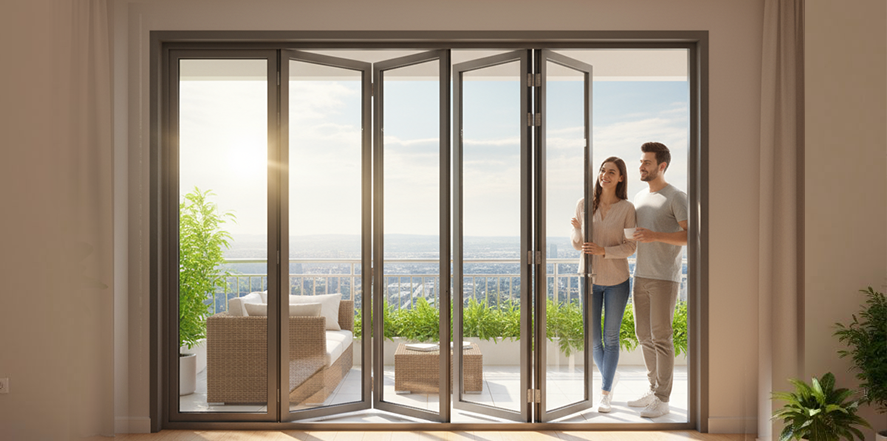


Two bi-fold door proposals can cover the same opening yet behave very differently. One may fold entirely to the left; another may provide a separate door for daily access. The difference begins with the number of operating leaves and how they are divided between the stacks.
In a typical one-sided arrangement, two leaves fold as a pair, while three leaves can be arranged with a lead leaf that opens independently. However, an even bifold door configuration can also include a traffic door. For example, a four-leaf arrangement may allow one leaf to open independently for everyday access, depending on the selected hardware system. Comparing bifold door configurations begins with that operating decision. The bifold door hardware layout must follow the actual folding pattern, access requirement and selected system—not panel count alone.
Quick selection guide
- Choose a two-leaf layout when the opening and selected system suit a simple folding pair and separate daily-use access is unnecessary.
- Consider a three-leaf layout when a lead or traffic door is important, subject to the system’s approved configuration.
- Consider a split arrangement when an even total leaf count must also provide independent access.
- Verify leaf dimensions, finished weights, stacking clearance, handing, locking sequence and the manufacturer’s configuration drawings before specifying hardware.
Count operating leaves before comparing layouts
In this guide, a leaf is one moving door sash. A three-leaf bi-fold has three operating sashes; it is different from an interior closet door with three decorative panels formed into its face. This distinction matters when comparing 2-panel vs 3-panel bifold doors: only the operating leaves determine where hinges, rollers, locks and guides are required.
A useful bifold door panel layout shows the door closed and open, identifies the side to which each group folds and marks any independently opening leaf. State the viewing direction on the drawing. Without it, “folds left” can mean opposite things to the designer and fabricator.
Across bifold door configurations, the notation should describe the split as well as the total. For example, 2+2 describes four leaves divided into two groups, while 3+1 describes four leaves arranged asymmetrically. Both have an even total count, but they need different operating and locking reviews.
2-panel vs 3-panel bifold doors: what changes?
The practical difference between 2-panel vs 3-panel bifold doors is the potential for an independently operated lead leaf and the change in individual leaf size. A conventional two-leaf, one-sided set works as a folding pair. A suitable three-leaf arrangement may let someone use one leaf as a traffic door without folding back the other two. The exact sequence depends on the selected system.
| Planning question | Two operating leaves | Three operating leaves |
| Typical one-sided movement | Two leaves fold together toward one jamb | A lead leaf may open separately before the remaining leaves fold |
| Daily-use access | Usually requires operating the folding pair | May be provided by a traffic door |
| Leaf size at the same overall width | Fewer, generally wider leaves | More, generally narrower leaves |
| Hardware review | Hinges, guides or rollers, locking and stack clearance for the pair | Those same interfaces, plus lead-leaf hinges, handle, lock and operating sequence where a traffic door is specified |
| Key qualification | Check the selected system’s minimum and maximum leaf dimensions | Confirm that its approved three-leaf arrangement provides the intended access |
Adding a leaf does not automatically make a door easier to operate. It introduces another meeting edge and changes how movement and locking are coordinated. Equally, using fewer leaves can push the width or weight of each sash beyond the hardware’s application range. These are reasons to compare complete assemblies, rather than choosing from a drawing of the closed elevation alone.
How even and odd arrangements affect access
An odd bifold door configuration often provides a straightforward route to a traffic door when an odd-numbered group folds to one side. The lead leaf can open for everyday passage, while the remaining leaves stay closed. Its hinges, handle, lock, clearances and relationship to the folding leaves all need to be shown on the hardware schedule.
An even bifold door configuration gives other useful choices. Two leaves can form a compact folding pair; four leaves might divide 2+2 or be arranged 3+1. A split such as 3+1 can provide a separately opening leaf if the chosen door system supports it. Thus, the question is not simply “even or odd?” It is where the leaves stack and which leaf, if any, must work on its own.
This is where the bifold door panel layout becomes an operational drawing. Mark the traffic door, the meeting stiles, the direction of swing and the space occupied by each folded stack. Then follow the opening sequence from the first handle movement to the fully open position. A layout that looks balanced when closed may put a handle against an adjacent leaf or place the stack in a circulation route when open. Show inward or outward folding separately from left or right stacking, and relate both choices to the threshold and clearance available on each side. These are project and selected-system decisions, not properties of the leaf count alone.
Turn the panel layout into a bifold door hardware layout
ال bifold door hardware layout should identify what supports, guides, connects and secures each leaf. A component list alone cannot show whether the parts work together in the proposed arrangement.
Begin with the load path: identify the specified rollers or carriers, their track interfaces and the hinges between leaves. Next, identify the active leaf and the order in which locks and shootbolts are released. Finally, check where the door closes against the frame and adjoining leaves. These steps are especially important when a traffic door is added, because daily-use access changes which leaf is operated most often.
A fabrication review should answer these questions:
- Which leaves fold together, and where do they stack? Show the open position on the plan, including clearance from walls, screens, furniture and nearby doors.
- Which leaf is operated independently? Locate its handle, hinges, locking points and meeting edge.
- How is each leaf supported? Relate the actual glazed weight and dimensions to the selected roller and hinge arrangement.
- What holds the remaining leaves closed? Identify the locking and shootbolt positions and the required operating sequence.
- Where can alignment be adjusted? Check the relevant adjustment ranges against the profile, threshold and finished installation.
This makes the bifold door hardware layout useful to both the specifier and the production team. It connects the intended user experience to the drawings and parts that must deliver it.
Check leaf size and weight against the chosen system
Comparing 2-panel vs 3-panel bifold doors at the same opening width illustrates why panel count is a technical decision. Across a nominal 2,400 mm opening, a simple division suggests approximately 1,200 mm per leaf with two leaves or 800 mm with three. Those are only starting figures: frame sections, clearances and the actual configuration change the finished sash dimensions.
For a fabricator, the next step is to calculate each finished leaf’s dimensions and weight, including its glazing and moving components. An odd bifold door configuration also calls for the lead-leaf operation to be shown on the drawing. Compare those values with the specific hardware configuration being proposed. A load figure cannot compensate for a sash that is outside the permitted width or height range.
CMECH’s even-configuration hardware gives a published sash width range of 500–900 mm, height range of 1,900–3,500 mm and a specification-table weight limit of 150 kg. Its odd-configuration hardware gives the same listed dimension ranges and describes 120 kg and 150 kg load-rating options. The appropriate rating and supported leaf arrangement need to be identified for the selected version.
That distinction also prevents a misleading shortcut: the approximate two-leaf dimensions in the example above would exceed the published 900 mm sash-width figure. Changing to three nominally narrower leaves could bring width into range, but width alone would not establish that CMECH has approved a three-leaf version for that project.
Where CMECH’s even and odd hardware fits into the review
CMECH separates its even and odd bi-fold hardware offerings. Both descriptions bring together guided rollers, multipoint locking, shootbolts and adjustable hinges. Both specify upper and lower dual-guide-wheel rollers and a lower-roller vertical adjustment range of −1.5 mm to +3 mm. Those details matter because a multi-leaf door depends on controlled movement and alignment across several meeting edges.
The configuration pages also report system durability exceeding 30,000 operations. That is a reported operation figure, not a limit on the number of times a finished door may be used or proof of its assembled air, water or structural performance. The project review still needs the exact configuration drawing, component schedule, profile interfaces and evidence required for the finished door.
For an even bifold door configuration, request the drawing that shows the proposed split and meeting edges. For an odd bifold door configuration, request the lead-leaf arrangement and its operating sequence if independent access is required. In both cases, the specified bifold door panel layout must match the actual set being fabricated.
Finalize bifold door configurations before ordering hardware
The strongest comparison of bifold door configurations is a marked-up assembly drawing, not a panel-count preference in isolation. It should show the finished opening, profile sections, each leaf’s size and weight, stack direction, traffic-door position, hardware references, locking sequence and required clearances.
That drawing gives the supplier a concrete application to assess. It also lets the fabricator identify a problem—such as an oversized leaf, an inaccessible handle or insufficient stack space—while the design can still be revised.
Frequently asked questions
What is the main difference between 2-panel vs 3-panel bifold doors?
A typical two-leaf, one-sided layout operates as a folding pair. A suitable three-leaf design may include a lead leaf for independent daily access. At the same overall width, three leaves are generally narrower than two, but the finished dimensions, weight and available traffic-door operation depend on the selected system.
Does an odd bifold door configuration always have a traffic door?
No. An odd bifold door configuration can make a traffic door practical, but the panel count alone does not specify its position, hardware or operating sequence. Check the approved drawing for the exact arrangement.
Can an even bifold door configuration include a traffic door?
Yes, in some supported split arrangements. An even bifold door configuration such as a four-leaf 3+1 layout can be planned around an independently opening leaf. A two-leaf folding pair should not be assumed to offer the same function.
What should a fabricator show on the bifold door panel layout?
ال bifold door panel layout should show each operating leaf, handing, stack direction, open position, traffic-door position and meeting edges. Pair it with a bifold door hardware layout that identifies hinges, rollers, handles, locks, shootbolts and the opening sequence.
Review the configuration with CMECH
The right choice among bifold door configurations depends on how people will use the opening and whether the finished leaves fit the selected hardware system. Send CMECH the proposed elevation, plan, profile sections, glazing details, finished leaf weights and access requirement. Contact CMECH to request configuration-specific drawings and discuss the appropriate even or odd hardware arrangement.
Editorial note — do not publish
Client confirmation required: Confirm whether CMECH’s current even and odd products support the two- and three-leaf examples respectively, and which 120 kg or 150 kg option applies to the proposed odd arrangement. The general bi-folding series page describes four, six or eight sashes and lists a 120 kg limit, so its figures should not be merged with the separate configuration pages.


 English
 Arabic
 Chinese
 French
 Thai
 Vietnamese